 Bug FAQ
Common Yamfly
Loxura atymnus · Order: Lepidoptera · Family: Lycaenidae
Also called: Yamfly
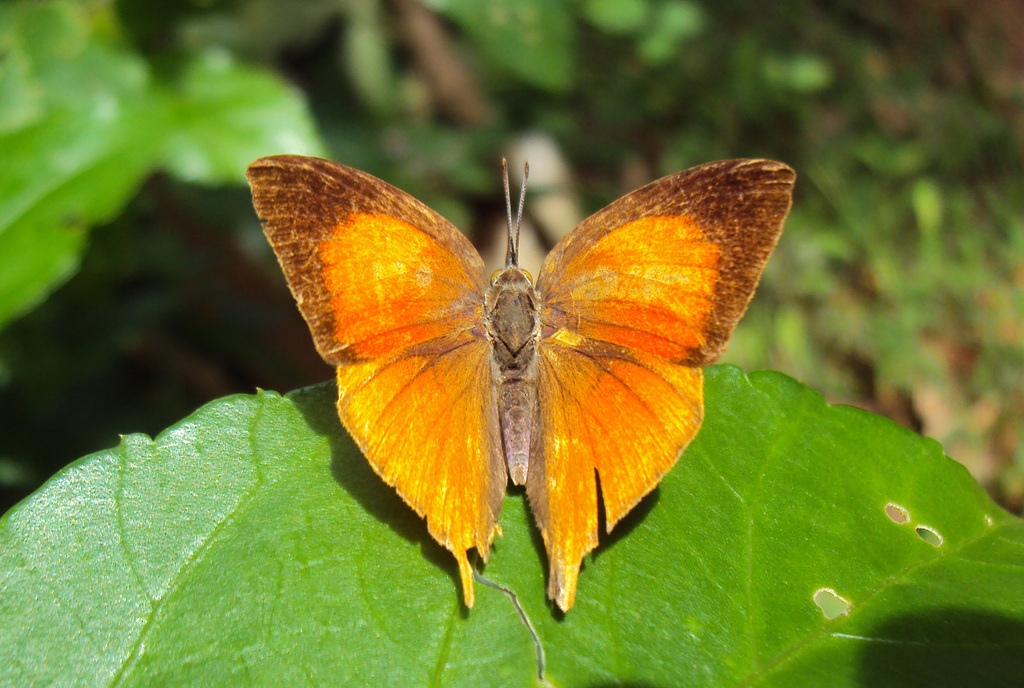
The common yamfly is a small blue butterfly found across Asia. Adults have a bright fulvous upperside, a black band along the forewing edge, and a narrow pale ochreous-brown margin on the hindwing. Its life cycle lasts about 23 to 26 days in the lab, allowing several generations each year.
Source: Wikipedia
How to recognize it
The upperside of the butterfly is bright fulvous. The forewing has a black band that starts at the middle of the costa, runs along the outer margin and curves inward.
Source: Wikipedia
Size
The wing span is about 0.92 mm, give or take 0.09 mm.
Source: Wikipedia
Where it lives
It lives in Asian habitats as a lycaenid or blue butterfly.
Source: Wikipedia
What it eats
The first three larval instars feed for 2 to 3 days each.
Source: Wikipedia
Life cycle
Under laboratory conditions the whole life cycle finishes in 23 to 26 days. Because the cycle is short, the species can produce several generations in a single year.
Source: Wikipedia
Where it comes from
Its native range is across Asia.
Source: Wikipedia
Questions people ask
How big is a common yamfly?
Its wing span is about 0.92 mm, with a small variation of ±0.09 mm.
Source: Wikipedia
Where does the common yamfly live?
It is found throughout Asia as a lycaenid (blue) butterfly.
Source: Wikipedia
What does a common yamfly look like?
Adults have a bright fulvous upperside, a black band along the forewing edge, and a narrow pale ochreous-brown margin on the hindwing.
Source: Wikipedia
How fast does the common yamfly develop?
Its life cycle takes about 23 to 26 days in the lab, allowing several generations each year.
Source: Wikipedia
Same family (Lycaenidae)

Sources
- Wikipedia: https://en.wikipedia.org/wiki/Loxura_atymnus
Look it up elsewhere: GBIF · iNaturalist · BugGuide · Wikipedia
Text written 2026-10-22 from the sources above and checked sentence by sentence against them. Data fetched 2026-10-22.