 Bug FAQ
Common Tit
Hypolycaena erylus · Order: Lepidoptera · Family: Lycaenidae

The common tit has two short tails on its hindwings, about 6 mm and 5 mm long. Males are pale blue to dark brown above with a shining purple sheen, while females are dark brown with a white broken band near the tornus. It is common at low elevations, where males gather at damp patches and females are rarely seen.
Source: Wikipedia
How to recognize it
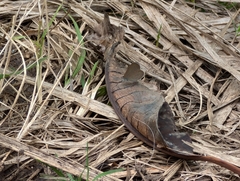
Both sexes have a pale greyish-brown underside. A white-edged black spot is present in cell 2 of the hindwing.
Source: Wikipedia
Size
The butterfly has two tails on the hindwing, one about 6 mm long at vein V1 and another about 5 mm long at vein V2.
Source: Wikipedia
Where it lives
It is abundant at low elevations. Males often form clusters on damp ground, while females are seldom observed.
Source: Wikipedia
What it eats
In India it has been recorded feeding on the plant Meyna pubescens.
Source: Wikipedia
Where it comes from
The common tit is found in India and South-East Asia.
Source: Wikipedia
Lookalikes
It belongs to the lycaenid (blues) family.
Source: Wikipedia
More photos


Questions people ask
What does the common tit look like?
Males are pale blue to dark brown above with a shining purple hue, females are dark brown with a white broken band near the tornus, and both have a pale grey-brown underside.
Source: Wikipedia
Where can I find the common tit?
It is common at low elevations in India and South-East Asia, where males gather on damp patches.
Source: Wikipedia
What plants does the common tit feed on?
In India it has been recorded feeding on Meyna pubescens.
Source: Wikipedia
Same family (Lycaenidae)



Sources
- Wikipedia: https://en.wikipedia.org/wiki/Hypolycaena_erylus
Look it up elsewhere: GBIF · iNaturalist · BugGuide · Wikipedia
Text written 2026-10-23 from the sources above and checked sentence by sentence against them. Data fetched 2026-10-22.