 Bug FAQ
Common Swift Moth
Korscheltellus lupulina · Order: Lepidoptera · Family: Hepialidae
Also called: Lupulina Ghost Moth, Common Swift
Source: Wikipedia
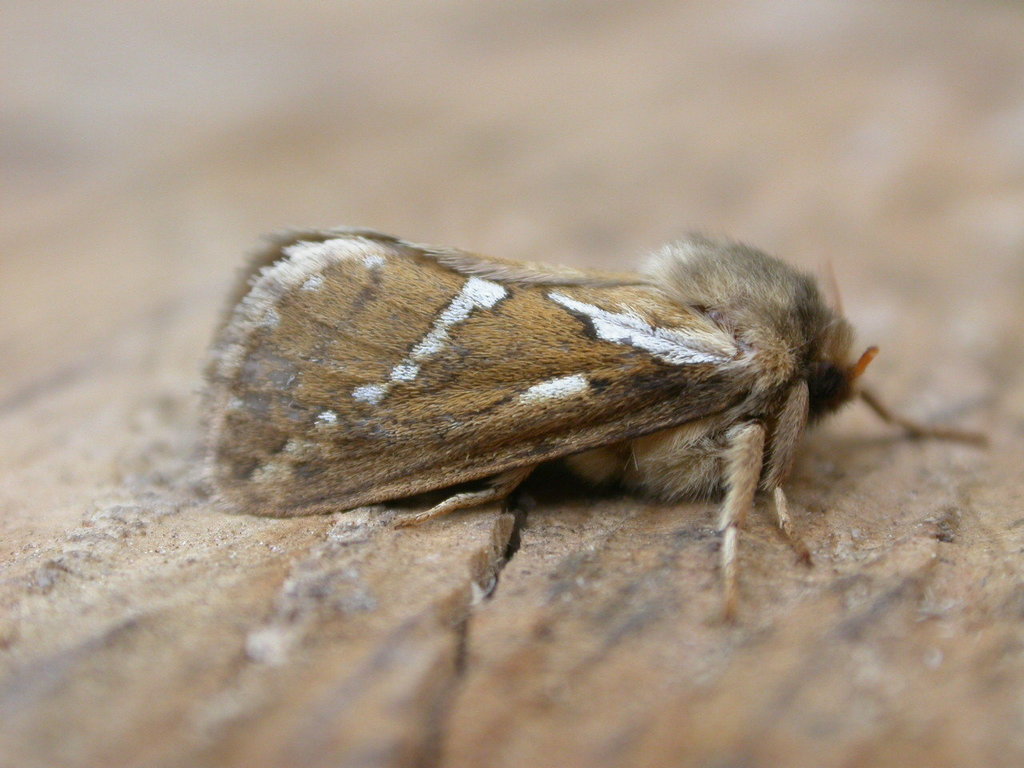
Males have about a 30 mm wingspan while females are larger at around 40 mm. The larvae live underground on plant roots, overwinter as larvae, and pupate in root tunnels before emerging as moths.
Source: Wikipedia
How to recognize it
Forewings are dark brown with white streaks that form a V shape and an extra spot near the leading edge; hindwings are plain brown.
Source: Wikipedia
Size
Male wingspan is about 30 mm. Female wingspan is about 40 mm.
Source: Wikipedia
Where it lives
It is a common and often abundant species throughout Europe.
Source: Wikipedia
What it eats
Larvae feed underground on the roots of many different plants. Adult moths have no proboscis and do not feed on flowers.
Source: Wikipedia
Life cycle
The species overwinters as a larva. It pupates in a tunnel among roots and uses spines on the pupa to reach the surface before emerging.
Source: Wikipedia
When you see it
Adults are active at dusk in May and June.
Source: Wikipedia
Where it comes from
Its native range is Europe, where it is common and abundant.
Source: Wikipedia
Status: introduced in Canada. Source: iNaturalist
Questions people ask
Do these moths bite or sting?
No, they have no mouthparts for biting and no stinger.
Source: Wikipedia
Can they damage my garden?
Yes, the larvae feed on the roots of many garden plants, which can harm or kill them.
Source: Wikipedia
Same family (Hepialidae)


Sources
- Wikipedia: https://en.wikipedia.org/wiki/Common_swift_moth
Look it up elsewhere: GBIF · iNaturalist · BugGuide · Wikipedia
Text written 2026-10-22 from the sources above and checked sentence by sentence against them. Data fetched 2026-10-22.