 Bug FAQ
Common red-legged robberfly
Dioctria rufipes · Order: Diptera · Family: Asilidae
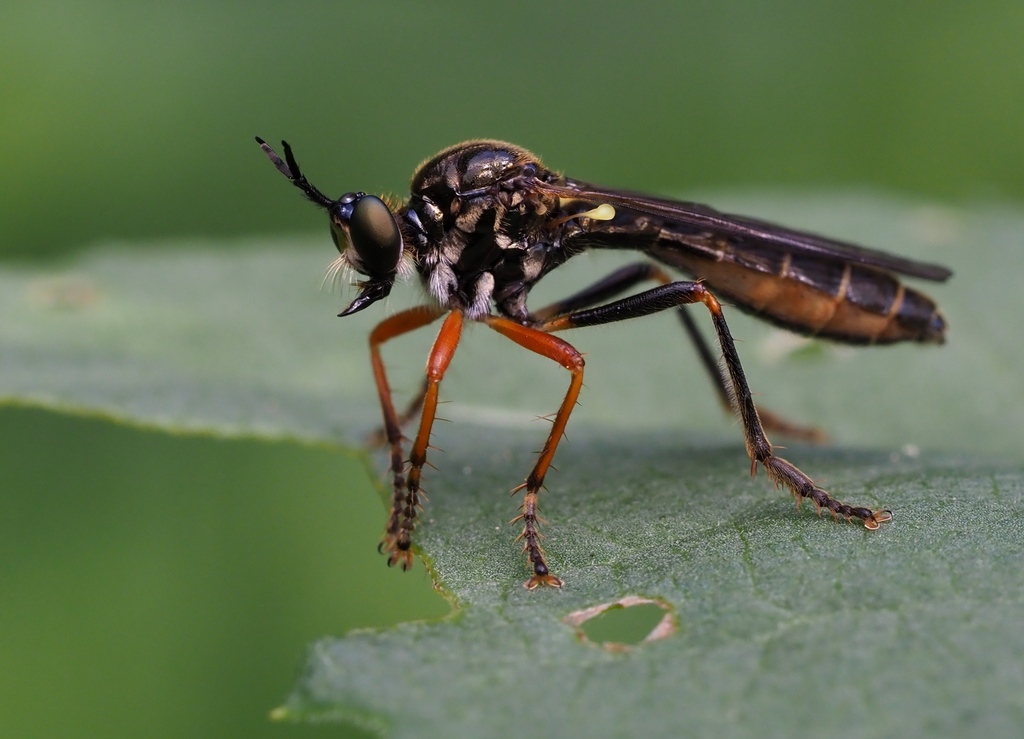
The common red-legged robberfly is a medium-large fly about 8 to 15 mm long with orange-red front legs and black hind legs. It lives in scrubby grassland, woodland edges and hedgerows across most of Europe, the Near East and the eastern Palearctic. Adults hunt other insects such as parasitic wasps and flies, while the larvae are ground-dwelling predators.
Source: Wikipedia
How to recognize it
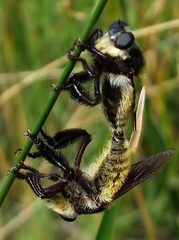
It has a black head with hard, piercing mouthparts. The front legs are completely orange-red, the hind legs are mainly black.
Source: Wikipedia
Size
Body length ranges from about 8 to 15 mm and wing length from 7.5 to 9 mm.
Source: Wikipedia
Where it lives
It prefers scrubby grassland, well-wooded areas, woodland edges and hedgerows. A stripe of pale, short, soft hairs runs along the sides of its thorax.
Source: Wikipedia
What it eats
Adults are predators of other insects, especially parasitic wasps, ichneumonids, sawflies and small flies.
Source: Wikipedia
Life cycle
Larvae develop as ground-dwelling predators.
Source: Wikipedia
When you see it
Adults are active from May through July or August.
Source: Wikipedia
Where it comes from
Found throughout most of Europe, the Near East and the eastern Palearctic region.
Source: Wikipedia
Lookalikes
They are hard to separate from other Dioctria species; identification keys are provided in several entomological works.
Source: Wikipedia
More photos

Questions people ask
When can I expect to see adult red-legged robberflies?
Adults are typically seen from May to July-August.
Source: Wikipedia
What do these flies eat?
They hunt other insects, mainly parasitic wasps, ichneumonids, sawflies and small flies.
Source: Wikipedia
Where do they live?
They inhabit scrubby grassland, woodland edges and hedgerows across much of Europe and nearby regions.
Source: Wikipedia
Same family (Asilidae)

Sources
- Wikipedia: https://en.wikipedia.org/wiki/Dioctria_rufipes
Look it up elsewhere: GBIF · iNaturalist · BugGuide · ITIS · Wikipedia
Text written 2026-10-23 from the sources above and checked sentence by sentence against them. Data fetched 2026-10-22.