 Bug FAQ
Common Raintree Spittlebug
Ptyelus grossus · Order: Hemiptera · Family: Aphrophoridae
Also called: Tipuana Spittlebug

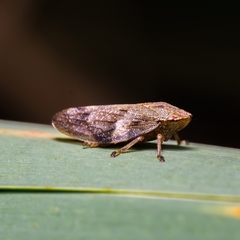
Adult common raintree spittlebugs have slate-grey wings with two pale patches near each outer edge and a white, rounded head marked with dark eyes and small black-yellow spots on the forehead. They feed on many plants, especially trees such as Tipuana, Peltophorum and Lonchocarpus, but also on Grevillea, Rhus, Acacia, Vangueria and Eucalyptus. The species gathers in groups as larvae and nymphs, and the young are preyed upon by the wasp Gorytes natalensis, the fly Leucophenga, and other predatory insects.
Source: Wikipedia
Where it lives
They are found feeding on a variety of plants.
Source: Wikipedia
What it eats
Preferred host trees are Tipuana, Peltophorum and Lonchocarpus, but they also eat Grevillea, Rhus, Acacia, Vangueria and Eucalyptus.
Source: Wikipedia
Life cycle
Larvae and nymphs are gregarious, forming groups.
Source: Wikipedia
Lookalikes
Nymphs share predators such as Gorytes natalensis and Leucophenga, which may be confused with other small insects.
Source: Wikipedia
More photos


Questions people ask
How can I recognize an adult common raintree spittlebug?
Look for slate-grey wings each with two pale patches near the edge and a white, rounded head with dark eyes and tiny black-yellow marks on the forehead.
Source: Wikipedia
What plants do they feed on?
They feed on many trees, especially Tipuana, Peltophorum and Lonchocarpus, and also on species like Grevillea, Rhus, Acacia, Vangueria and Eucalyptus.
Source: Wikipedia
Same family (Aphrophoridae)



Sources
- Wikipedia: https://en.wikipedia.org/wiki/Ptyelus_grossus
Look it up elsewhere: GBIF · iNaturalist · BugGuide · Wikipedia
Text written 2026-10-23 from the sources above and checked sentence by sentence against them. Data fetched 2026-10-23.