 Bug FAQ
Common Palmfly
Elymnias hypermnestra · Order: Lepidoptera · Family: Nymphalidae
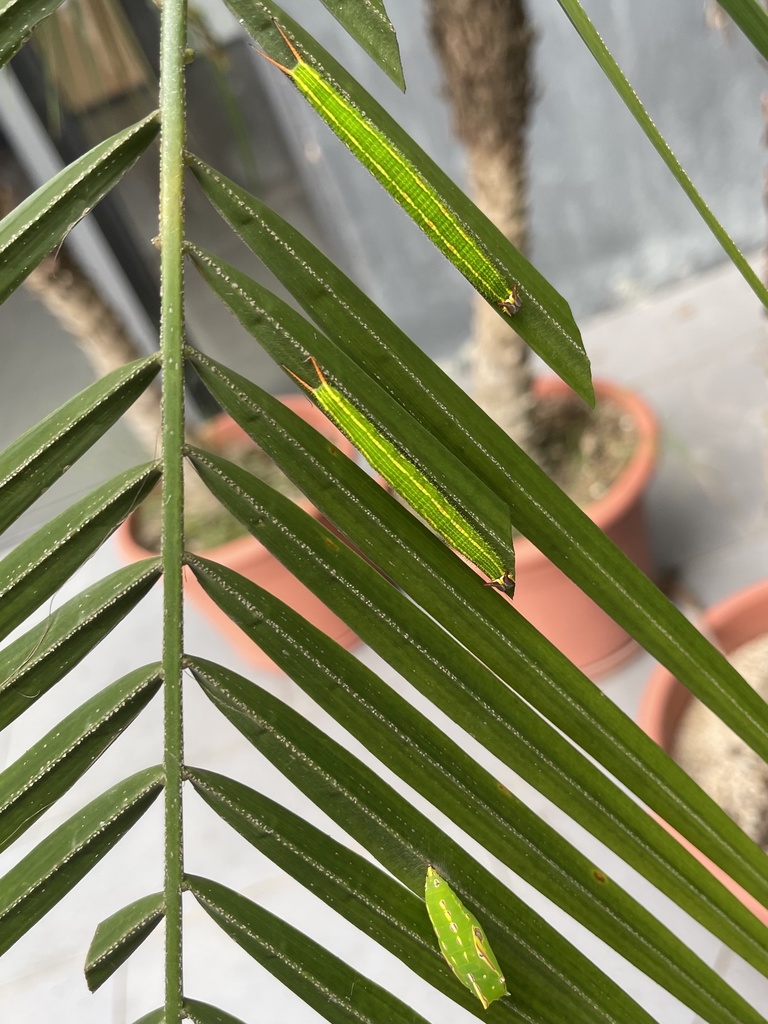
Males have black forewings with small blue patches and look like Euploea butterflies, while females mimic Danaus species. It occurs in Peninsular India, the sub-Himalayas and Southeast Asia. The caterpillars are known to eat each other.
Source: Wikipedia
How to recognize it
Males are black on the upper side of the forewings with small blue spots and imitate Euploea butterflies; females imitate butterflies of the genus Danaus.
Source: Wikipedia
What it eats
The larvae are cannibalistic, sometimes eating other caterpillars of the same species.
Source: Wikipedia
Life cycle
The caudata form of the caterpillar is bright green with yellow lines and spots, a large head with two short horns, and a pair of long rear spines. The undularis form is elongated, green with yellow dorsal and lateral lines, yellow spots edged in red and blue, and a brown head with two erect setose processes.
Source: Wikipedia
Where it comes from
Found in Peninsular India, the sub-Himalayan region and Southeast Asia.
Source: Wikipedia
Lookalikes
Male Common Palmfly looks very similar to the male of the race E. undularis on both upper and underside.
Source: Wikipedia
Same family (Nymphalidae)






Sources
- Wikipedia: https://en.wikipedia.org/wiki/Elymnias_hypermnestra
Look it up elsewhere: GBIF · iNaturalist · BugGuide · Wikipedia
Text written 2026-10-22 from the sources above and checked sentence by sentence against them. Data fetched 2026-10-22.