 Bug FAQ
Common Oogpister
Anthia thoracica · Order: Coleoptera · Family: Carabidae
Also called: Yellow Epaulette Ground Beetle
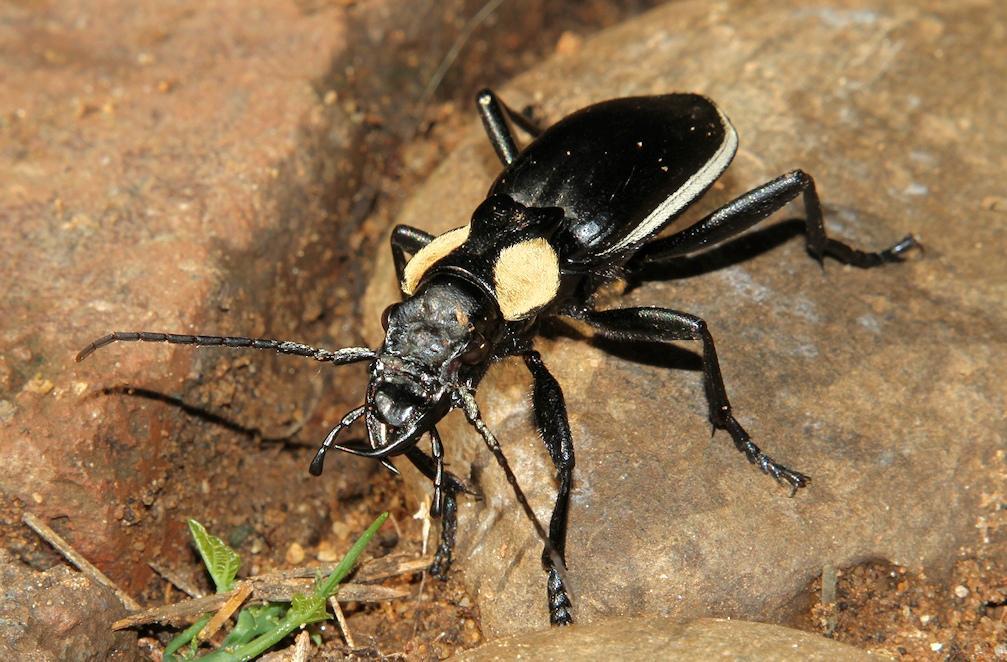
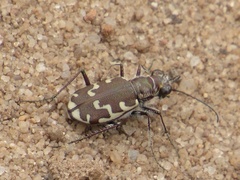
The Common Oogpister grows to about 47 to 53 mm long, roughly two inches. It is black with yellowish hair patches on the sides of the pronotum and a whitish hair band along the edges of the wing covers. This beetle lives in parts of southern Africa, including Namibia, Tanzania and South Africa.
Source: Wikipedia
How to recognize it
Males have long, strong jaws, and the beetle’s pronotum has wide side flanges while the smooth, oval wing covers show eight straight lines.
Source: Wikipedia
Size
Adults reach a length of about 47 to 53 mm (1.9 to 2.1 in).
Source: Wikipedia
Where it comes from
It is found in Namibia, Tanzania and South Africa.
Source: Wikipedia
Questions people ask
What does the Common Oogpister look like?
It is a black beetle with yellowish hair patches on the pronotum sides and a whitish hair band along the wing-cover edges, and males have long, strong mandibles.
Source: Wikipedia
How big does the Common Oogpister get?
Adults grow to about 47 to 53 mm in length, roughly two inches.
Source: Wikipedia
Where is the Common Oogpister found?
It occurs in Namibia, Tanzania and South Africa.
Source: Wikipedia
Same family (Carabidae)


Sources
- Wikipedia: https://en.wikipedia.org/wiki/Anthia_thoracica
Look it up elsewhere: GBIF · iNaturalist · BugGuide · Wikipedia
Text written 2026-10-23 from the sources above and checked sentence by sentence against them. Data fetched 2026-10-23.