 Bug FAQ
Common Mother-of-Pearl
Protogoniomorpha parhassus · Order: Lepidoptera · Family: Nymphalidae
Also called: Forest Mother-of-Pearl
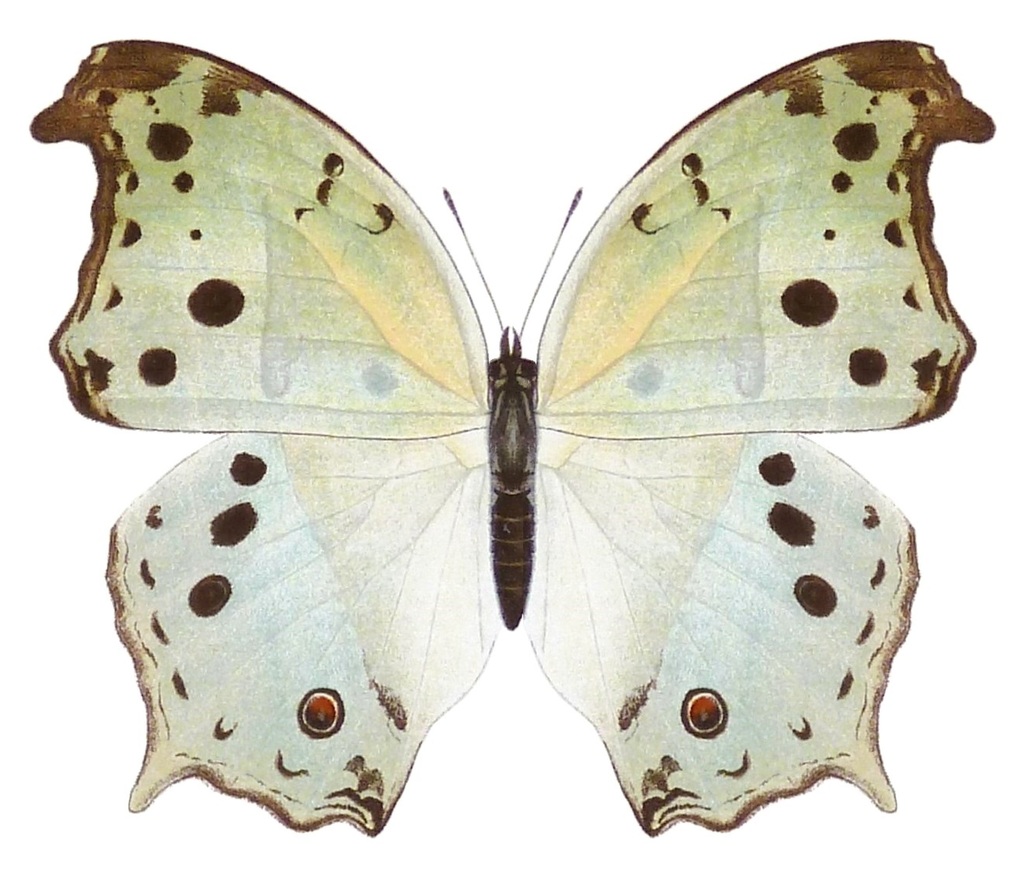
Its upper wings are greenish-white with a violet shine in the wet season and pearly white in the dry season, featuring a black-tipped hooked forewing apex, red eyespots ringed in black, and black marginal spots. Adults fly year-round, especially in summer and autumn, and they move with a fast, ponderous flapping flight.
Source: Wikipedia
How to recognize it
The forewing apex is black-tipped and hooked. There are a few red eyespots ringed with black on the wings. Black spots appear near the margins of both forewings and hindwings.
Source: Wikipedia
Size
Males have a wingspan of 65 to 80 mm; females are larger at 75 to 90 mm.
Source: Wikipedia
Where it lives
It lives in forested areas of Africa.
Source: Wikipedia
What it eats
Adults feed on plants such as Asystasia, Brillantaisia, Isoglossa, Mimulopsis and Paulowilhelmia species.
Source: Wikipedia
Life cycle
Adults are on the wing throughout the year, with peaks in summer and autumn. Their flight is a fast, ponderous flapping motion.
Source: Wikipedia
When you see it
Adult flight occurs year-round, especially in summer and autumn.
Source: Wikipedia
Where it comes from
Its native range is forested parts of Africa.
Source: Wikipedia
Lookalikes
The larvae resemble those of Junonia and Precis species but are larger. The pupae also look like those of Junonia and Precis species, though larger.
Source: Wikipedia
Same family (Nymphalidae)






Sources
- Wikipedia: https://en.wikipedia.org/wiki/Protogoniomorpha_parhassus
Look it up elsewhere: GBIF · iNaturalist · BugGuide · Wikipedia
Text written 2026-10-23 from the sources above and checked sentence by sentence against them. Data fetched 2026-10-22.