 Bug FAQ
Common Mormon Swallowtail
Papilio polytes · Order: Lepidoptera · Family: Papilionidae
Also called: Common Mormon

The Common Mormon Swallowtail is a large butterfly with a wingspan of about 90 to 100 mm and a black ground colour marked by rows of white spots on both fore- and hindwings. It lives in many forest types as well as gardens and other human-made habitats across a wide range of South and Southeast Asian countries. Adults are most often seen during the monsoon and post-monsoon months, and females perch on exposed branches while laying eggs.
Source: Wikipedia
How to recognize it
The butterfly is jet black with a series of white spots along the middle of the hindwing and a line of decreasing white spots toward the apex of the forewing.
Source: Wikipedia
Size
Its wingspan measures roughly 90 to 100 mm (3.5 to 3.9 in).
Source: Wikipedia
Where it lives
It inhabits deciduous, semi-evergreen and evergreen forests, and is also common in gardens and other areas of human habitation.
Source: Wikipedia
Life cycle
Females perch on exposed branches with wings open or closed while laying eggs.
Source: Wikipedia
When you see it
The butterfly is most common during the monsoon and post-monsoon months.
Source: Wikipedia
Lookalikes
Female Common Mormons are polymorphic, showing different forms.
Source: Wikipedia
More photos
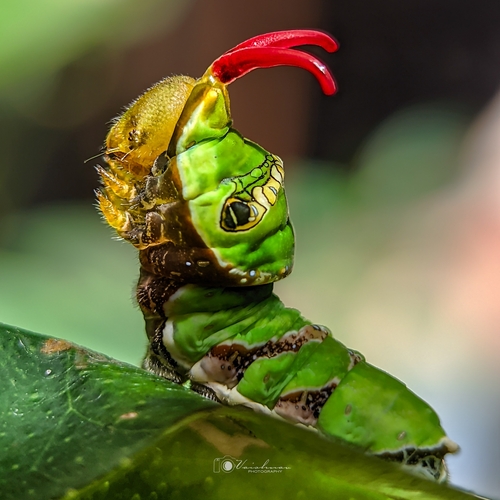
Same family (Papilionidae)

Sources
- Wikipedia: https://en.wikipedia.org/wiki/Common_Mormon
Look it up elsewhere: GBIF · iNaturalist · BugGuide · Wikipedia
Text written 2026-10-22 from the sources above and checked sentence by sentence against them. Data fetched 2026-10-22.