 Bug FAQ
Common Jay
Graphium doson · Order: Lepidoptera · Family: Papilionidae

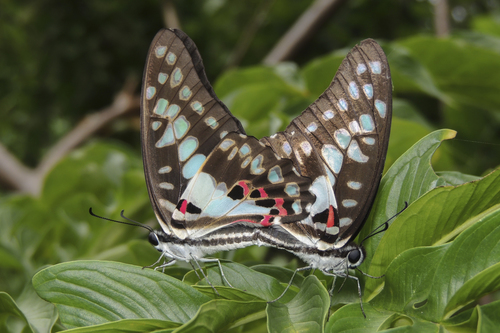
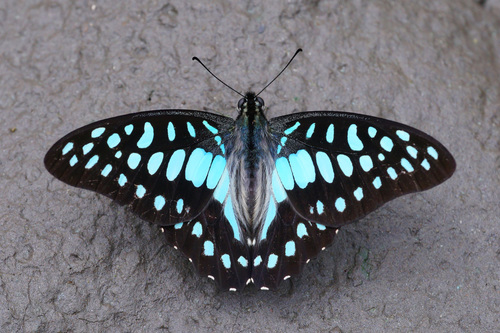
The Common Jay is a black swallow-tail butterfly with pale blue, semi-transparent spots forming a central band on its wings. It lives in thick, moist forests across much of Southeast Asia, from Sri Lanka and southern India up to the Himalayan foothills.
Source: Wikipedia
How to recognize it
The upper side is black with large pale blue spots that make a central band, plus a row of smaller marginal spots. The underside is brown with similar markings but appears whitish.
Source: Wikipedia
What it eats
Caterpillars feed on plants in the Annonaceae, Lauraceae and Magnoliaceae families such as Annona, Cinnamomum, Magnolia, Hunteria, Michelia, Trachelospermum and Polyalthia species.
Source: Wikipedia
Life cycle
Eggs are spherical, pale yellow and laid singly on the underside of leaves.
Source: Wikipedia
Where it comes from
It is widespread throughout Southeast Asia, including lower elevations of Sri Lanka, southern India, the Eastern Ghats, Satpura, Bengal, Assam, Bangladesh and the Himalayan foothills. It is scarce in southern Honshū, Japan.
Source: Wikipedia
Lookalikes
The species was first described by the father-son entomologists Cajetan and Rudolf Felder.
Source: Wikipedia
More photos

Same family (Papilionidae)
Sources
- Wikipedia: https://en.wikipedia.org/wiki/Graphium_doson
Look it up elsewhere: GBIF · iNaturalist · BugGuide · Wikipedia
Text written 2026-10-22 from the sources above and checked sentence by sentence against them. Data fetched 2026-10-22.