 Bug FAQ
Common Four-ring
Ypthima huebneri · Order: Lepidoptera · Family: Nymphalidae
Also called: common fourring
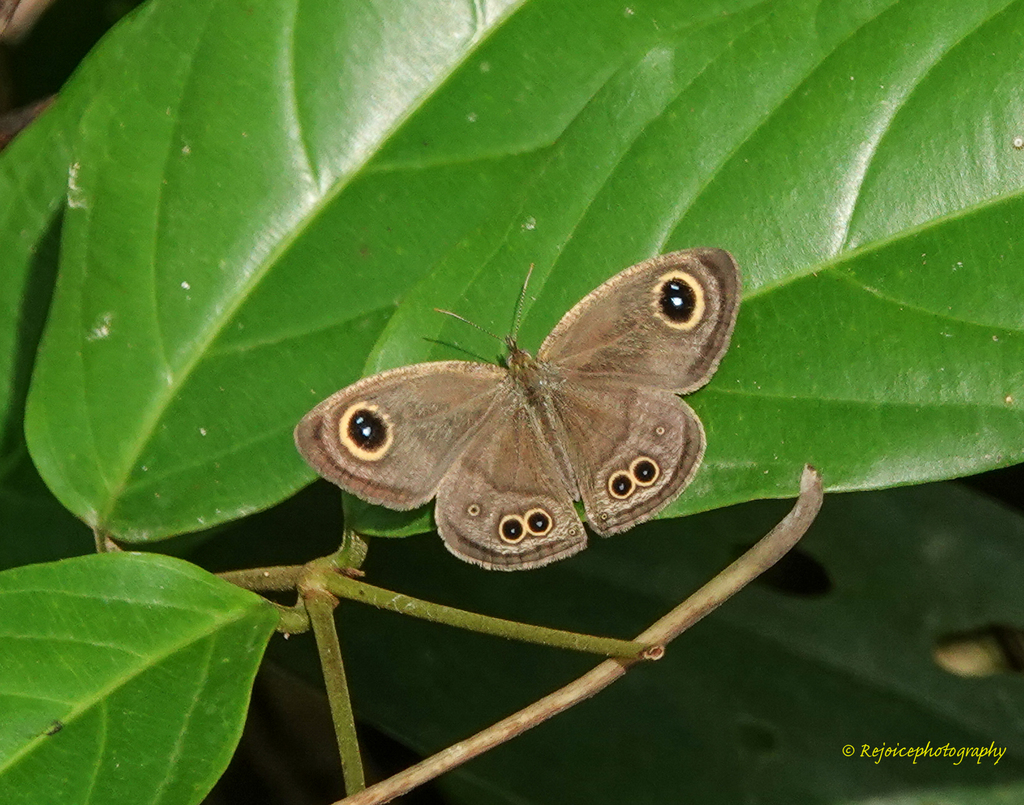
The common four-ring butterfly has a wingspan of about 33 to 43 mm and is greyish-brown above with distinctive eye-like spots on its wings. It lives in the Himalayas, parts of India, Sri Lanka and across South-East Asia, and its caterpillars feed on grasses such as Axonopus compressus.
Source: Wikipedia
How to recognize it
The upper side of the wings is greyish brown. The forewing shows a large, double-pupilled, yellow-ringed black spot near the tip. The hindwing usually has two small single-pupilled spots beyond the middle, sometimes three or none.
Source: Wikipedia
Size
Some individuals measure 33 to 39 mm across.
Source: Wikipedia
What it eats
Caterpillars feed on the grass Axonopus compressus.
Source: Wikipedia
Life cycle
The larva is about 25 mm long and has two backward-pointing processes from the anal segment. The pupa is green or brown, with a rounded head, raised wing-case edges, a humped thorax and dark brown wavy lines and spots.
Source: Wikipedia
Lookalikes
The pale western Indian form var. jocularia resembles the typical butterfly. Race kashmira differs by having a darker, more uniform upperside and a dull brownish underside.
Source: Wikipedia
More photos

Same family (Nymphalidae)






Sources
- Wikipedia: https://en.wikipedia.org/wiki/Ypthima_huebneri
Look it up elsewhere: GBIF · iNaturalist · BugGuide · Wikipedia
Text written 2026-10-22 from the sources above and checked sentence by sentence against them. Data fetched 2026-10-22.