 Bug FAQ
Common Crow
Euploea core · Order: Lepidoptera · Family: Nymphalidae
Also called: Common Indian Crow
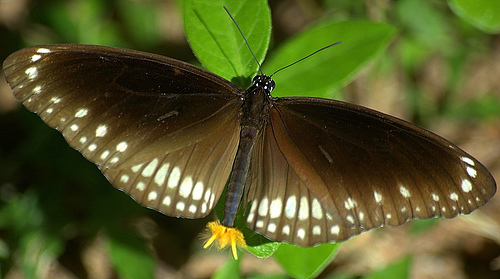
It lives in South Asia to Australia, often seen fluttering low over trees and sometimes mud-puddling on hot days. Adults feed on flower nectar, while caterpillars store plant toxins that carry through to the adult stage.
Source: Wikipedia
How to recognize it
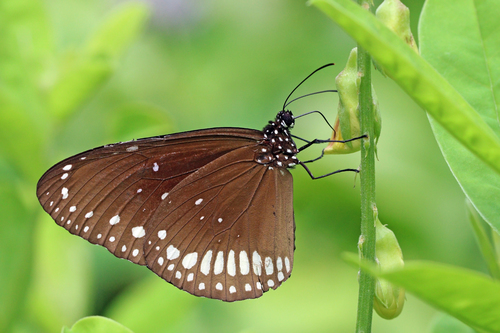
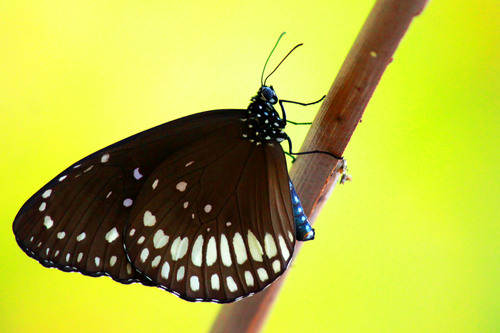
It has a glossy black upper side and brown underside with white markings along the wing margins. Males show a velvety black brand on the forewing upperside and a matching white streak underneath.
Source: Wikipedia
Size
Wingspan ranges from about 8 to 9 cm, and the body displays prominent white spots.
Source: Wikipedia
Does it bite or sting?
The species is unpalatable, which deters predators and leads to mimicry by edible butterflies.
Source: Wikipedia
Where it lives
Often seen gliding just above the ground, searching for nectar flowers.
Source: Wikipedia
What it eats
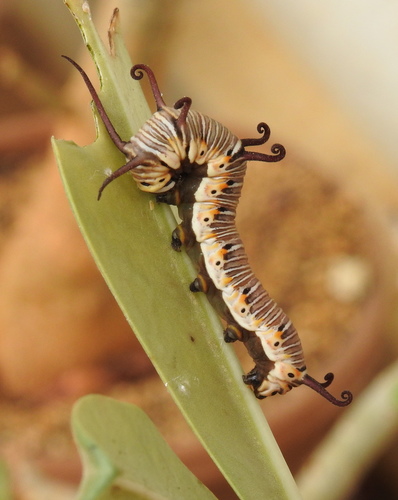
Adults sip nectar from flowers at a leisurely pace. Caterpillars ingest toxins from their host plants, which persist into adulthood.
Source: Wikipedia
Life cycle
Males visit plants such as Crotalaria and Heliotropium to gather pheromones for attracting females.
Source: Wikipedia
When you see it
On warm days large numbers gather on wet sand to mud-puddle.
Source: Wikipedia
Where it comes from
Found from southern Pakistan through India, Bangladesh, Myanmar, China, Sri Lanka, and into Australia.
Source: Wikipedia
Lookalikes
Similar species include the Brown King Crow (E. klugii) and the Double-branded Crow (E. sylvester).
Source: Wikipedia
More photos
Questions people ask
Where might I see a Common Crow butterfly?
They are common in South Asia to Australia and are often seen low over trees or mud-puddling on warm days.
Source: Wikipedia
Same family (Nymphalidae)






Sources
- Wikipedia: https://en.wikipedia.org/wiki/Euploea_core
Look it up elsewhere: GBIF · iNaturalist · BugGuide · Wikipedia
Text written 2026-10-22 from the sources above and checked sentence by sentence against them. Data fetched 2026-10-22.