 Bug FAQ
Common Baron
Euthalia aconthea · Order: Lepidoptera · Family: Nymphalidae
Also called: The Baron
Source: Wikipedia

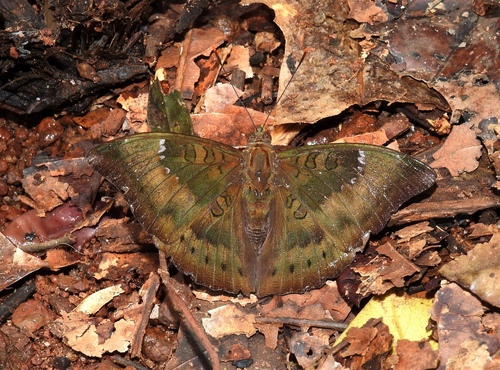
Males are brown with a hint of olive, females are a paler brown. Wingspan ranges from about 68 to 79 mm (2.7 to 3.1 in). It flies low with a stiff flap-glide style, defending a small territory.
Source: Wikipedia
How to recognize it
Males are brown with slight olive traces. Females look similar but are a paler shade.
Source: Wikipedia
Is it a pest in the house?
The green pupa on mango is sometimes treated as a minor pest.
Source: Wikipedia
Where it lives
It flies with a stiff flap-glide pattern. It stays low to the ground and holds a small territory.
Source: Wikipedia
What it eats
Caterpillars feed on cashew (Anacardium occidentale), Scurrula vines and mango (Mangifera indica).
Source: Wikipedia
Life cycle
The pupa is green, quadrangular and often found on mango trees.
Source: Wikipedia
When you see it
Recorded throughout peninsular India (except deserts and high Himalayas), Assam, Burma, Tenasserim, the Malay Peninsula and Sumatra.
Source: Wikipedia
Lookalikes
Race *vasanta* occurs in Sri Lanka. Race *acontius* occurs in the Andaman Islands.
Source: Wikipedia
More photos

Questions people ask
Does the common baron damage crops?
Its larvae can feed on mango leaves and fruit, making it a minor pest of mango trees.
Source: Wikipedia
Same family (Nymphalidae)






Sources
- Wikipedia: https://en.wikipedia.org/wiki/Euthalia_aconthea
Look it up elsewhere: GBIF · iNaturalist · BugGuide · Wikipedia
Text written 2026-10-22 from the sources above and checked sentence by sentence against them. Data fetched 2026-10-22.