 Bug FAQ
Coconut Rhinoceros Beetle
Oryctes rhinoceros · Order: Coleoptera · Family: Scarabaeidae
Also called: Asian Rhinoceros Beetle, Asiatic Rhinoceros Beetle, Coconut Palm Rhinoceros Beetle, Indian rhinoceros beetle
Source: Wikipedia

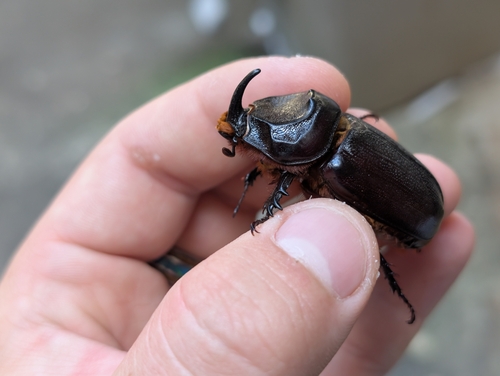
The beetle is a large, dark brown to black beetle about 35 to 50 mm long with a male horn and distinctive pronotum and leg teeth. It breeds in decaying palm trunks, sawdust, compost heaps and other organic waste, especially coconut and oil palm trunks. Adults are nocturnal flyers and can cause serious damage to palm fronds and seedlings, lowering nut yields or killing the plant.
Source: Wikipedia
How to recognize it
Males have a prominent head horn; the pronotum shows a central depression with two rear humps, and the front leg tibia has three large teeth.
Source: Wikipedia
Size
Adults measure 35 to 50 mm in length and are dark brown to black.
Source: Wikipedia
Is it a pest in the house?
Infestations can severely damage palm fronds, reducing leaf area and nut yield, and may kill newly planted palms by destroying their growing point.
Source: Wikipedia
How to get rid of it
Quarantine and removal of breeding sites require substantial resources and incur costs.
Source: Wikipedia
Where it lives
Breeding sites include decaying palm trunks, sawdust heaps at sawmills, garden compost, rubber-tree stumps and piles of cocoa pods.
Source: Wikipedia
What it eats
The beetle mainly uses decaying coconut or oil palm trunks for breeding, where females break the wood into fine particles for the larvae.
Source: Wikipedia
Life cycle
Eggs are white and about 3 mm across; larvae are typical C-shaped white scarab grubs.
Source: Wikipedia
When you see it
Adults are active at night and only fly after dark.
Source: Wikipedia
Where it comes from
It is native to tropical Asia, from India and the Maldives eastward through Myanmar, Thailand, Malaysia, Vietnam, Indonesia, the Philippines, Taiwan and southern China.
Source: Wikipedia
Lookalikes
Also called the coconut rhinoceros beetle or Asiatic rhinoceros beetle, it belongs to the Dynastinae subfamily and is typically 4 to 5 cm long.
Source: Wikipedia
Where it is found in the US
Recorded in 2 of 51 states and DC. Most records: Hawaii, Kansas.
Darker = more records. Counts are museum and citizen-science records, not population size.
Source: GBIF
Months it is reported in the US
Source: GBIF
More photos


Questions people ask
How can I prevent coconut rhinoceros beetles from damaging my palms?
Remove and destroy decaying palm trunks, sawdust piles and compost heaps where the beetles breed.
Source: Wikipedia
When are adult coconut rhinoceros beetles active?
They are nocturnal and only fly at night.
Source: Wikipedia
What size are coconut rhinoceros beetles?
Adults are 35 to 50 mm long and dark brown to black.
Source: Wikipedia
What does the male beetle look like?
Males have a pronounced head horn and the pronotum has a central depression with two rear humps; the front leg tibia bears three large teeth.
Source: Wikipedia
Same family (Scarabaeidae)
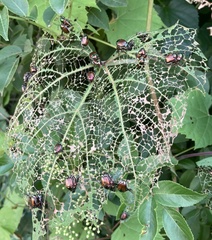 Japanese BeetlePopillia japonicaDamages trees, gardens or crops
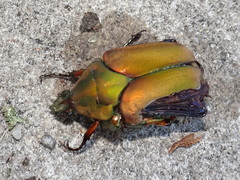 Common Green June BeetleCotinis nitidaDamages trees, gardens or crops
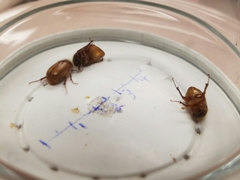 Phyllophaga crinitaPhyllophaga crinitaDamages trees, gardens or crops
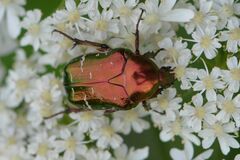 European Rose ChaferCetonia aurata
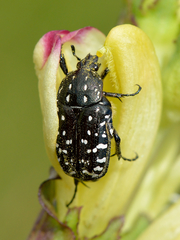 Mediterranean Spotted ChaferOxythyrea funestaDamages trees, gardens or crops
 Oriental BeetleExomala orientalisDamages trees, gardens or crops
Sources
- Wikipedia: https://en.wikipedia.org/wiki/Oryctes_rhinoceros
Look it up elsewhere: GBIF · iNaturalist · BugGuide · Wikipedia
Text written 2026-10-22 from the sources above and checked sentence by sentence against them. Data fetched 2026-10-22.