 Bug FAQ
Claret Pondhawk
Erythemis mithroides · Order: Odonata · Family: Libellulidae
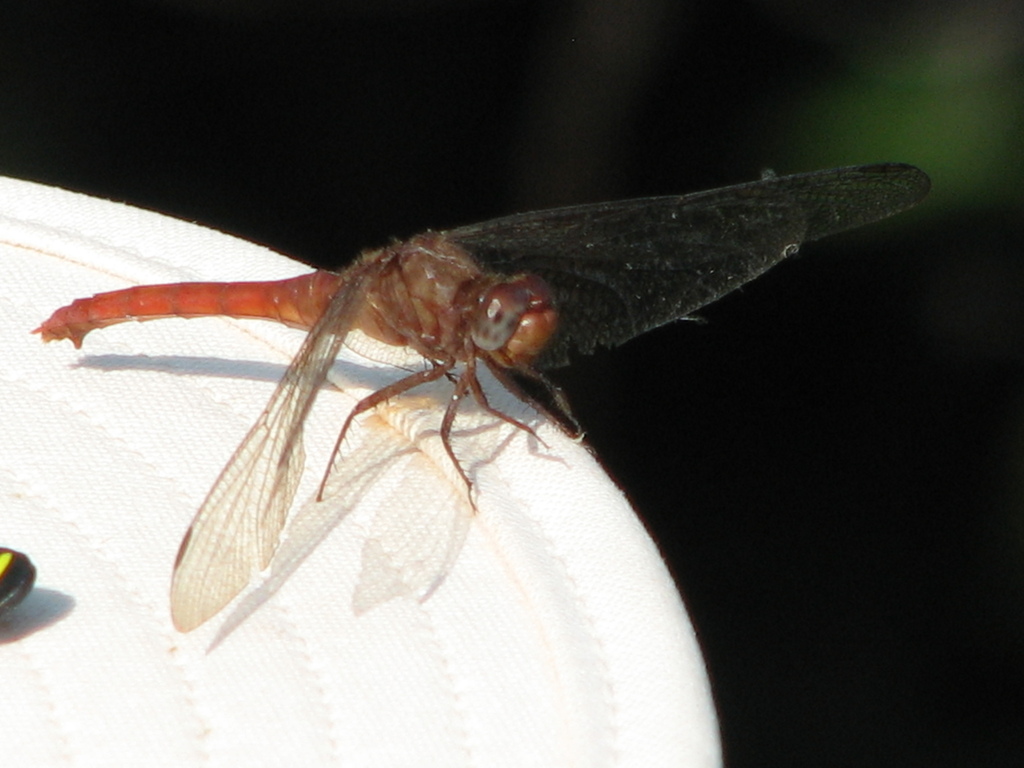
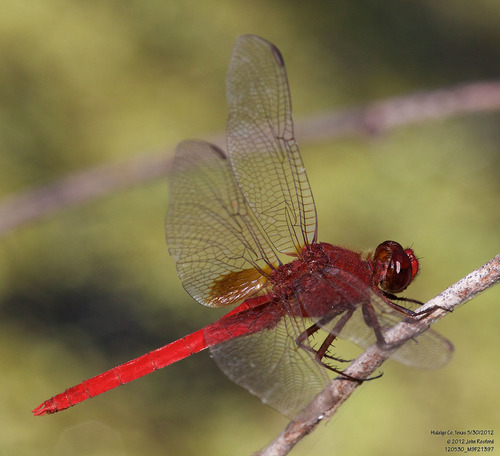
Male claret pondhawks have a yellow or brown lip that may show a dark stripe down the middle. Their thorax is red or brown with a reddish sheen and lacks light dorsal stripes, while the abdomen is entirely red with red appendages and wings that have a brown spot at the base and clear tips. They live around many types of still water such as swamps, ponds, lakes and reservoirs, often near secondary vegetation or agricultural areas.
Source: Wikipedia
How to recognize it
The front and tip of the body are red, the thorax shows red or brown tones with a reddish shine and no light stripes on top, the abdomen is fully red with red tail parts, and the wings have a brown spot near the base and clear or lightly colored tips.
Source: Wikipedia
Size
The front and apex of the body are red, and the thorax is red or brown with reddish reflections, lacking light dorsal stripes.
Source: Wikipedia
What it eats
Dragonflies are efficient predators that eat large numbers of insects in both their adult and larval stages, and they themselves are prey for birds, fish, reptiles, amphibians and other arthropods; they also serve as bioindicators of freshwater quality.
Source: Wikipedia
Life cycle
The larvae are small, ochre-colored and have a head that is wider than it is long. Their abdomen is short and cylindrical with the distal end pointing upward, and the tail appendages bear many setae.
Source: Wikipedia
Where it comes from
It occurs in southeast Texas and Mexico as well as throughout North and Central America, the Antilles, and most of South America except Chile.
Source: Wikipedia
Lookalikes
The genus Erythemis shows extensive homoplasy and structural variability, making it not a monophyletic group and leading to many look-alike species.
Source: Wikipedia
Where it is found in the US
Recorded in 1 of 51 states and DC. Most records: Texas.
Darker = more records. Counts are museum and citizen-science records, not population size.
Source: GBIF
Months it is reported in the US
Source: GBIF
More photos
Questions people ask
What does the claret pondhawk look like?
Males have a yellow or brown lip that may have a dark stripe, a red front and tip, a thorax that is red or brown with a reddish sheen and no light stripes, a completely red abdomen with red tail parts, and wings with a brown basal spot and clear tips.
Source: Wikipedia
Where can I find claret pondhawks?
They are found around still-water habitats like swamps, ponds, lakes and reservoirs, often near secondary vegetation, crops or other human-altered areas.
Source: Wikipedia
What region does this species inhabit?
It lives in southeast Texas, Mexico, the rest of North and Central America, the Antilles and most of South America except Chile.
Source: Wikipedia
What do claret pondhawk larvae look like?
The larvae are small, ochre-colored with a head that is wider than it is long, a short cylindrical abdomen that points upward, and tail appendages covered in many setae.
Source: Wikipedia
Same family (Libellulidae)

Sources
- Wikipedia: https://en.wikipedia.org/wiki/Erythemis_mithroides
Look it up elsewhere: GBIF · iNaturalist · BugGuide · ITIS · Wikipedia
Text written 2026-10-23 from the sources above and checked sentence by sentence against them. Data fetched 2026-10-23.