 Bug FAQ
Chryxus Arctic
Oeneis chryxus · Order: Lepidoptera · Family: Nymphalidae
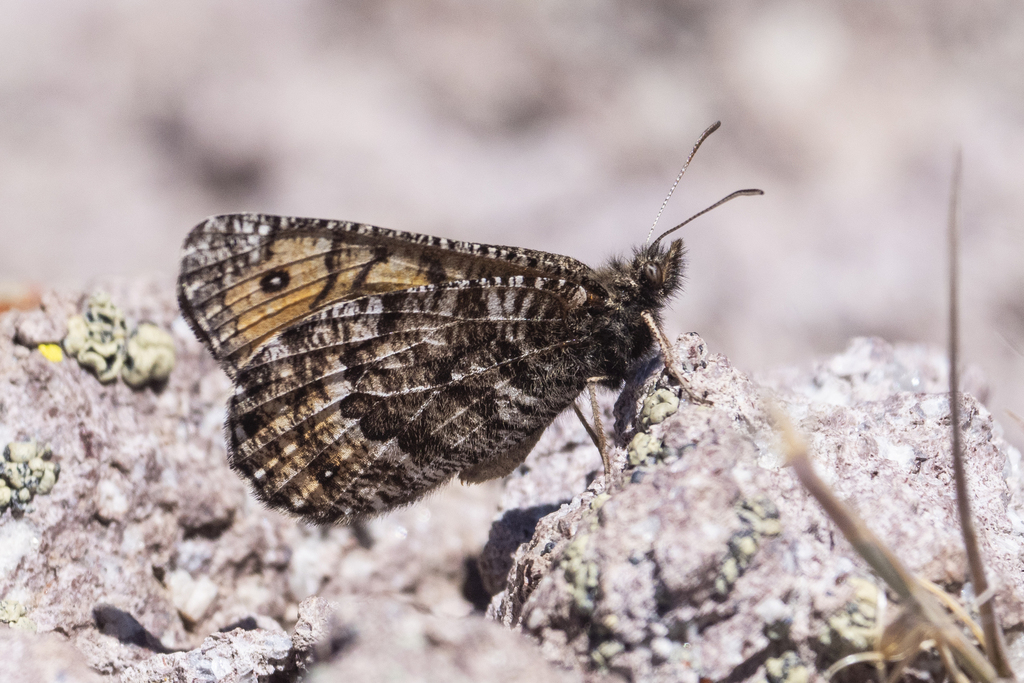
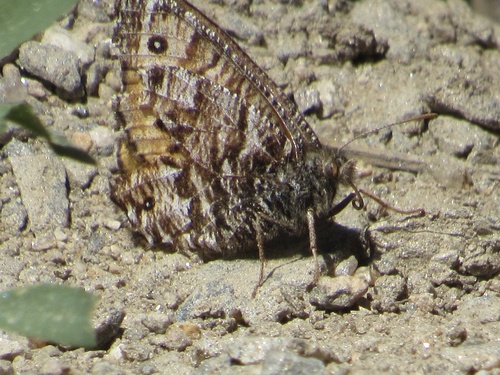
The brown Arctic butterfly has a wingspan of about 4 to 5.5 cm. Its upper wings are a creamy orange-brown with darker edges, while the underside of the hindwings shows a mottled gray-brown pattern with a broad, vague dark band. Adults feed on flower nectar and mineral-rich mud, and the caterpillars eat local grasses, taking two years to develop before emerging as adults every other year.
Source: Wikipedia
How to recognize it
Upper wings are creamy orange-brown with darker margins; the hindwing underside is striped gray-brown with a wide, faint dark middle band. The forewing upperside often has two to four black eye spots near the edge, and the hindwing may have up to two.
Source: Wikipedia
Size
Wingspan ranges from 39 mm to 54 mm.
Source: Wikipedia
Where it lives
Prefers sparsely vegetated mountainous areas with short summers. Also occurs in prairies, steppes, mountaintops and forest edges.
Source: Wikipedia
What it eats
Adults sip nectar from a variety of flowers.
Source: Wikipedia
Life cycle
Caterpillars feed on local grasses and need two years to mature. Consequently, adult butterflies appear only once every two years.
Source: Wikipedia
When you see it
The species has a biennial flight period in many areas because of its two-year larval development. Populations emerging in successive years are temporally separate.
Source: Wikipedia
Where it comes from
Native to the far northwest of Canada and the United States.
Source: Wikipedia
Lookalikes
Similar species include Great Arctic, Macoun's Arctic, Uhler's Arctic, Alberta Arctic, and Sentinel Arctic.
Source: Wikipedia
Where it is found in the US
Recorded in 16 of 51 states and DC. Most records: Colorado, Michigan, Idaho, Wyoming, California, Utah, Montana, Washington.
Darker = more records. Counts are museum and citizen-science records, not population size.
Source: GBIF
Status: native in North America; native in Canada; native in United States. Source: iNaturalist
Months it is reported in the US
Source: GBIF
More photos
Questions people ask
What do brown Arctic butterflies eat?
Adults feed on nectar from many flowers and also drink mineral-rich mud; the larvae eat local grasses.
Source: Wikipedia
Where can I find brown Arctic butterflies?
They live in the far northwest of North America, including western Canada and the northwestern United States such as Alaska, Idaho and California.
Source: Wikipedia
How often do brown Arctic butterflies appear?
Because their caterpillars take two years to develop, adults emerge only once every two years.
Source: Wikipedia
What habitats do they prefer?
They favor sparsely vegetated mountain areas with short summers, as well as prairies, steppes, mountaintops and forest edges.
Source: Wikipedia
Same family (Nymphalidae)






Sources
- Wikipedia: https://en.wikipedia.org/wiki/Oeneis_chryxus
Look it up elsewhere: GBIF · iNaturalist · BugGuide · ITIS · Wikipedia
Text written 2026-10-23 from the sources above and checked sentence by sentence against them. Data fetched 2026-10-23.