 Bug FAQ
Chilean Petaltail
Phenes raptor · Order: Odonata · Family: Petaluridae

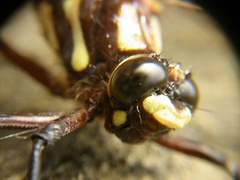
The Chilean petaltail is a dragonfly with black face, a thin crossbar above the mouth, widely spaced eyes that meet at a central dot, and a leaf-like patterned abdomen. Its hindwings measure about 35 to 52 mm, it lives in Chile and other parts of South America, and its larvae have been found near the Malleco River and on a farm mill. It is a predator and the sole species in the genus Phenes.
Source: Wikipedia
How to recognize it
The face is black with a thin crossbar above the mouth, eyes are far apart and join at a central dot, and the abdomen shows leaf-like patterns.
Source: Wikipedia
Size
The hindwings are roughly 35 to 52 mm long.
Source: Wikipedia
What it eats
It is a predator.
Source: Wikipedia
Life cycle
It is the only member of its genus, Phenes.
Source: Wikipedia
Where it comes from
It is native to Chile and other parts of South America.
Source: Wikipedia
Lookalikes
There are no other species in the genus Phenes, so it has no close look-alikes.
Source: Wikipedia
More photos


Questions people ask
What does the Chilean petaltail look like?
It has a black face with a thin crossbar above the mouth, widely spaced eyes that meet at a central dot, and a leaf-like patterned abdomen.
Source: Wikipedia
Where can I find this dragonfly?
It occurs in Chile and other parts of South America; larvae have been found near the Malleco River and on a farm mill.
Source: Wikipedia
Same family (Petaluridae)



Sources
- Wikipedia: https://en.wikipedia.org/wiki/Phenes
Look it up elsewhere: GBIF · iNaturalist · BugGuide · ITIS · Wikipedia
Text written 2026-10-23 from the sources above and checked sentence by sentence against them. Data fetched 2026-10-23.