 Bug FAQ
Children’s Stick Insect
Tropidoderus childrenii · Order: Phasmida · Family: Phasmatidae
Also called: Children's Stick Insect
Source: Wikipedia

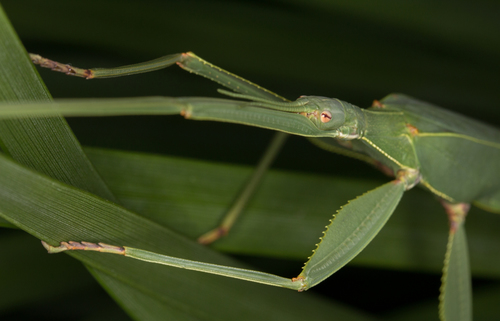
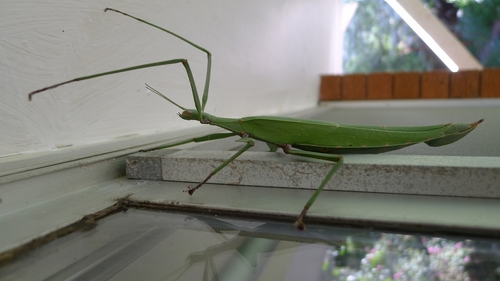
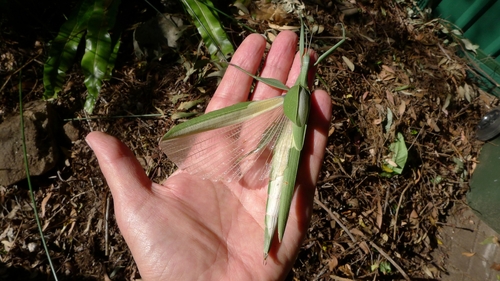
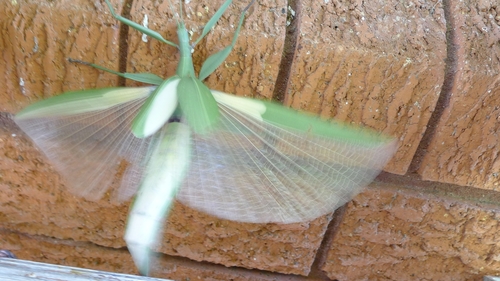
Adult females are medium green and look like leaves, making them hard to see in foliage. Each hindwing has a hidden dark blue spot near the base that is visible when the wings are opened. They grow to about 110 mm (4.3 in) long.
Source: Wikipedia
How to recognize it
Females are medium green and resemble leaves, blending into foliage.
Source: Wikipedia
Size
They are relatively large, measuring about 110 mm (4.3 in) in length.
Source: Wikipedia
Where it lives
They live where eucalyptus trees are common, since they feed on eucalyptus leaves.
Source: Wikipedia
Life cycle
Adult females mate multiple times and lay eggs throughout their adult life. Eggs are laid in winter and hatch in autumn.
Source: Wikipedia
More photos
Questions people ask
What do Children’s stick insects eat?
They feed on the leaves of gum and eucalyptus trees.
Source: Wikipedia
Same family (Phasmatidae)
 Smooth Stick InsectClitarchus hookeri
 Margin-winged Stick InsectCtenomorpha marginipennisDamages trees, gardens or crops
 Prickly Stick InsectAcanthoxyla prasinaDamages trees, gardens or crops
 Spur Legged PhasmidDidymuria violescens
 Spiny Leaf insectExtatosoma tiaratumCan irritate skin
 Titan Stick InsectAcrophylla titan
Sources
- Wikipedia: https://en.wikipedia.org/wiki/Tropidoderus_childrenii
Look it up elsewhere: GBIF · iNaturalist · BugGuide · Wikipedia
Text written 2026-10-23 from the sources above and checked sentence by sentence against them. Data fetched 2026-10-23.