 Bug FAQ
Chalkhill Blue
Polyommatus coridon · Order: Lepidoptera · Family: Lycaenidae
Also called: Chalk Hill Blue
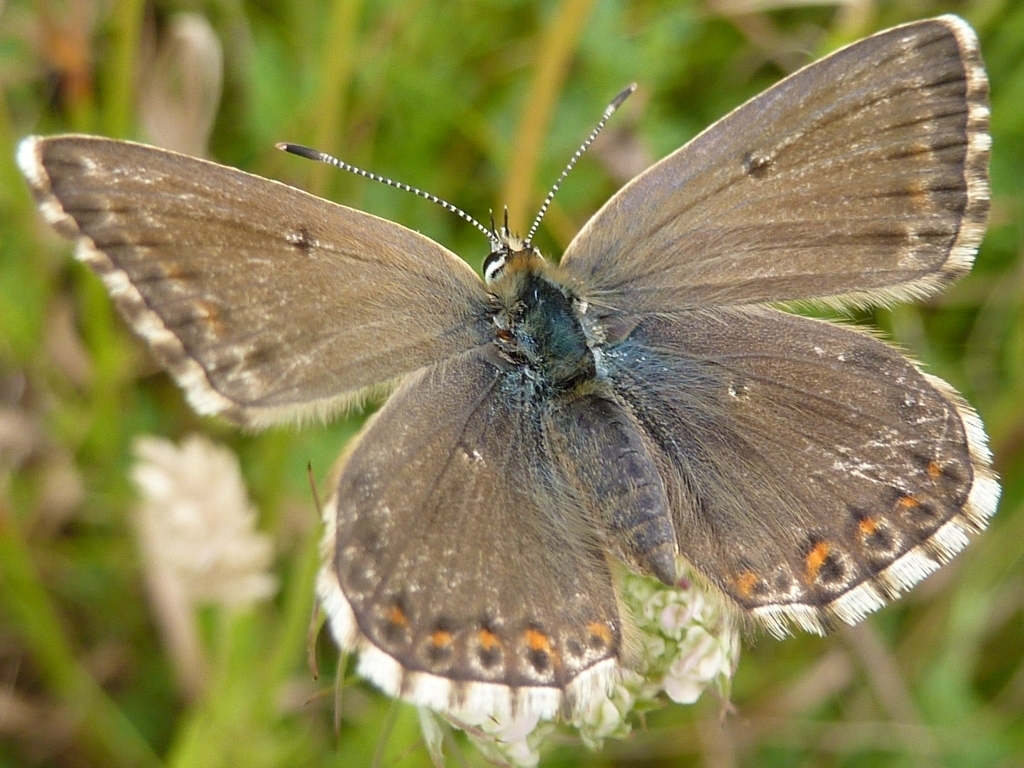
The Chalkhill Blue has a wingspan of about 30 to 36 mm and the females show dark brown upper wings with orange edge spots and checkered fringes. It lives on dry, calcareous grasslands with short, flower-rich swards, from 100 to 2,000 m elevation. Adults fly from June to August and the species is found across central and western Europe in the Palearctic realm.
Source: Wikipedia
How to recognize it
Females have dark brown upper wings with orange marginal spots and a checkered fringe pattern.
Source: Wikipedia
Size
The wingspan ranges from 30 to 36 mm.
Source: Wikipedia
Where it lives
Prefers dry, calcareous grasslands at 100 to 2,000 m altitude. Favors short grass areas rich in flowering plants.
Source: Wikipedia
What it eats
Adults feed on plants such as Hippocrepis, Coronilla, Astragalus, and Vicia until June. They are visited by the ant Formica flava, which is attracted to a dorsal gland.
Source: Wikipedia
Life cycle
The pupa is slender, smooth, dirty yellow-brown with a dark dorsal line and pale smears on the wing cases, usually found on the ground under stones.
Source: Wikipedia
When you see it
Adults are on the wing from June through August, being common in some locales and rare in others.
Source: Wikipedia
Where it comes from
Also found in the western, southern, and central parts of the Palearctic realm, including Asia Minor and the south Urals.
Source: Wikipedia
Lookalikes
Field identification relies on underside wing markings, as many blue butterflies look similar. Various aberrations are common within the species.
Source: Wikipedia
Questions people ask
Are they a garden pest?
They feed on a range of flowering plants but are not reported to damage crops or gardens.
Source: Wikipedia
Where can I see a Chalkhill Blue?
Look for them on dry, calcareous grasslands with short, flower-rich swards between June and August.
Source: Wikipedia
Same family (Lycaenidae)

Sources
- Wikipedia: https://en.wikipedia.org/wiki/Chalkhill_blue
Look it up elsewhere: GBIF · iNaturalist · BugGuide · Wikipedia
Text written 2026-10-22 from the sources above and checked sentence by sentence against them. Data fetched 2026-10-22.