 Bug FAQ
Caterpillar hunting wasp
Delta dimidiatipenne · Order: Hymenoptera · Family: Eumenidae

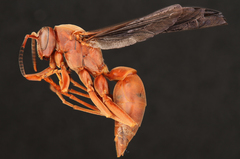
Females are about 20 to 23 mm long and males a little shorter, 19 to 22 mm. These potter wasps live in desert areas but can also be found in gardens of eastern Arabia and across a wide range from Morocco to India and Nepal.
Source: Wikipedia
Where it lives
It is considered a desert species but also occurs in gardens in eastern Arabia.
Source: Wikipedia
What it eats
Adults feed on nectar, such as that from Acacia flowers. The nest is stocked with several caterpillars, which the larva eats while developing.
Source: Wikipedia
Life cycle
After the mud hardens, she lays a single egg inside, suspending it from the roof with a silk thread.
Source: Wikipedia
Lookalikes
It is a large, red-coloured potter wasp of the genus Delta found in warm Palearctic regions.
Source: Wikipedia
Where it is found in the US
Recorded in 1 of 51 states and DC. Most records: California.
Darker = more records. Counts are museum and citizen-science records, not population size.
Source: GBIF
More photos


Questions people ask
How big are they?
Females are 20 to 23 mm long and males are slightly smaller at 19 to 22 mm.
Source: Wikipedia
Where can I find them?
They are desert specialists but also appear in gardens of eastern Arabia, and their range stretches from Morocco across North Africa to the Middle East, India and Nepal.
Source: Wikipedia
What do they eat?
Adults sip nectar, especially from Acacia flowers, while the larvae eat caterpillars that the female supplies in the mud nest.
Source: Wikipedia
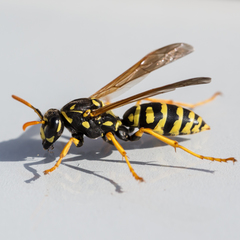
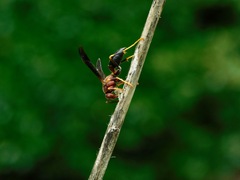
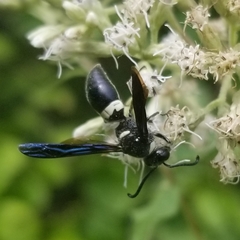
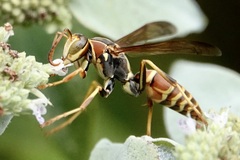
Same family (Eumenidae)



Sources
- Wikipedia: https://en.wikipedia.org/wiki/Delta_dimidiatipenne
Look it up elsewhere: GBIF · iNaturalist · BugGuide · Wikipedia
Text written 2026-10-23 from the sources above and checked sentence by sentence against them. Data fetched 2026-10-23.