 Bug FAQ
Carabus auronitens
Carabus auronitens · Order: Coleoptera · Family: Carabidae
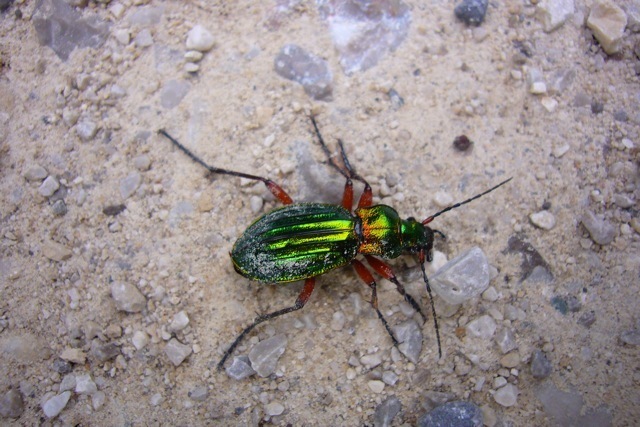
The beetle is 18 to 32 mm long and has a shiny head and elytra that can be red-golden, red-green or rarely blue, with three dark longitudinal veins on each wing case. It lives under loose bark, in dead wood or bogs, often in mountainous areas up to 2 500 m, and is found across central, eastern and western Europe. Adults are active from May to September and hunt at night, feeding on small animals such as snails, worms and other insects.
Source: Wikipedia
How to recognize it
The head and elytra are shiny and may be red-golden, red-green or rarely blue, with three sturdy dark veins on each elytron.
Source: Wikipedia
Size
Adults grow to a length of 18 to 32 mm (0.71 to 1.26 in).
Source: Wikipedia
Where it lives
Found under loose bark, in dead wood, and in bogs, especially in mountains or foreland up to 2 500 m.
Source: Wikipedia
What it eats
The adult beetle is nocturnal and preys on smaller animals such as snails, worms and insects.
Source: Wikipedia
Life cycle
Adults appear from May to September; larvae climb trees up to about 7 m and pupate after three moults.
Source: Wikipedia
When you see it
Adults are present from May through September.
Source: Wikipedia
Where it comes from
Its range includes central, eastern and western Europe.
Source: Wikipedia
Lookalikes
It can be told apart from the similar Carabus auratus by its dark longitudinal veins and by having only the first antenna segment red, whereas C. auratus has green-gold veins and four red antenna segments.
Source: Wikipedia
Questions people ask
What does Carabus auronitens look like?
It has a shiny head and wing covers that can be red-golden, red-green or rarely blue, with three dark veins on each wing case; the prothorax is narrow and reddish-copper, legs are black with red femora, and the first antenna segments are red.
Source: Wikipedia
Where can I find Carabus auronitens?
It lives under loose bark, in dead wood, and in bogs, especially in mountainous regions up to 2 500 m, across central, eastern and western Europe.
Source: Wikipedia
What does Carabus auronitens eat?
The adult beetle hunts at night and feeds on small animals such as snails, worms and other insects.
Source: Wikipedia
Same family (Carabidae)


Sources
- Wikipedia: https://en.wikipedia.org/wiki/Carabus_auronitens
Look it up elsewhere: GBIF · iNaturalist · BugGuide · Wikipedia
Text written 2026-10-22 from the sources above and checked sentence by sentence against them. Data fetched 2026-10-22.