 Bug FAQ
Canary Red Admiral
Vanessa vulcania · Order: Lepidoptera · Family: Nymphalidae
Also called: Godart's Admiral
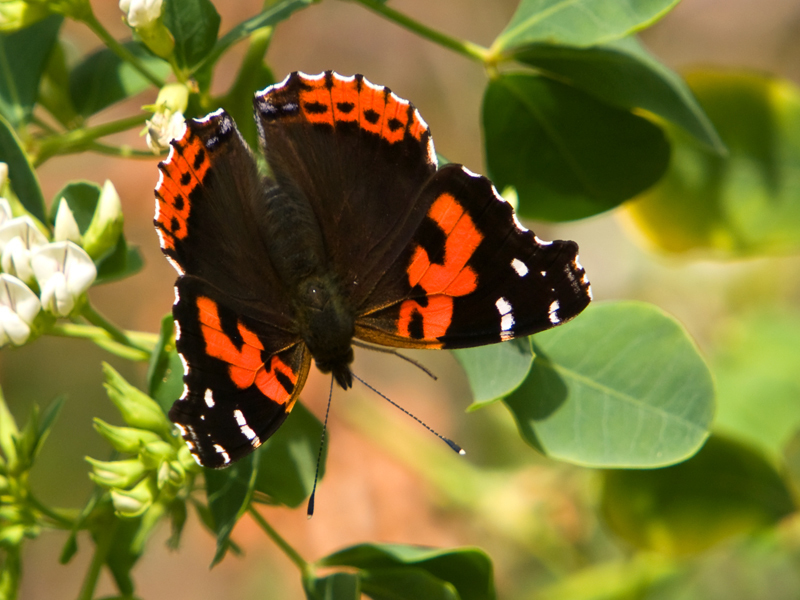
The Canary Red Admiral has a wingspan of about 54 to 60 mm. It is darker than the similar Vanessa indica, with a lighter red, strongly wavy band on the forewing and large spots on the hindwing margin.
Source: Wikipedia
Size
The wingspan ranges from 54 to 60 mm.
Source: Wikipedia
What it eats
The larvae feed on the nettles Urtica morifolia and Urtica urens.
Source: Wikipedia
Life cycle
It was formerly treated as a subspecies of Vanessa indica but was raised to full species status after research by Leestmans in 1992.
Source: Wikipedia
Where it comes from
Its native range includes the Canary Islands (except Lanzarote) and Madeira.
Source: Wikipedia
Lookalikes
A similar form, Vanessa occidentalis, is smaller and darker, occurs in Madeira and has occasional records from Portugal.
Source: Wikipedia
Where it is found in the US
Recorded in 1 of 51 states and DC. Most records: California.
Darker = more records. Counts are museum and citizen-science records, not population size.
Source: GBIF
Questions people ask
What do the caterpillars eat?
Caterpillars feed on the nettles Urtica morifolia and Urtica urens.
Source: Wikipedia
Same family (Nymphalidae)






Sources
- Wikipedia: https://en.wikipedia.org/wiki/Vanessa_vulcania
Look it up elsewhere: GBIF · iNaturalist · BugGuide · Wikipedia
Text written 2026-10-23 from the sources above and checked sentence by sentence against them. Data fetched 2026-10-23.