 Bug FAQ
Canary Blue
Cyclyrius webbianus · Order: Lepidoptera · Family: Lycaenidae

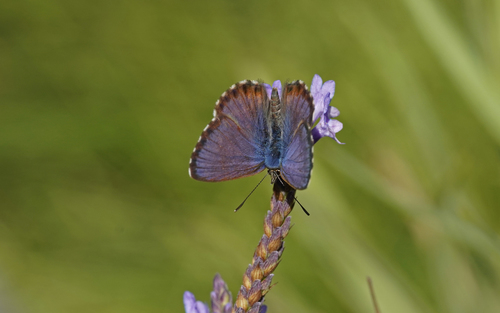
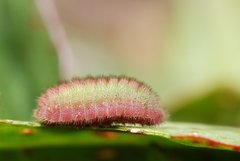
The Canary Blue butterfly has a wingspan of about 28 to 34 mm and is dark brown with a dull blue shine on top. It lives only in the Canary Islands, favoring coastal areas and can be seen all year, especially in August, on Tamarisk and Adenocarpus flowers. Caterpillars feed on Lotus, Cytisus and Ononis plants.
Source: Wikipedia
How to recognize it
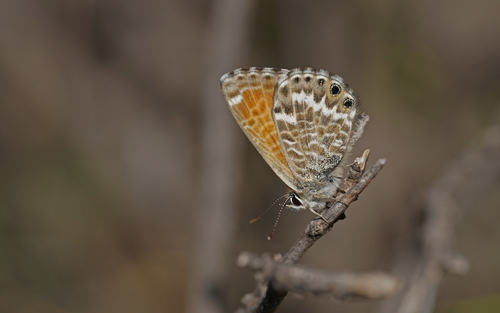
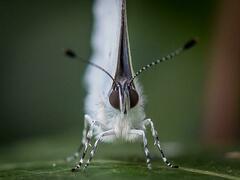
Both males and females are dark brown above with a faint blue gloss. The underside shows a variegated pattern: the forewing disc is yellow-brown with white spots near the tip, and the hindwing is dark grey-brown with light streaks and an irregular white band; the wing edges have spotted fringes.
Source: Wikipedia
Size
The wingspan ranges from 28 to 34 mm.
Source: Wikipedia
Where it lives
It inhabits coastal zones. Adults are active throughout the year, most commonly in August, flying among Tamarisk branches and visiting Adenocarpus viscosus flowers.
Source: Wikipedia
What it eats
Adults visit the flowers of Adenocarpus viscosus.
Source: Wikipedia
Life cycle
Adults are on the wing all year round.
Source: Wikipedia
When you see it
The butterfly flies from March to August, up to 3,000 m altitude, and is especially common in August.
Source: Wikipedia
Where it comes from
The species is endemic to the Canary Islands.
Source: Wikipedia
Lookalikes
It may be confused with P. webbianus Brullé (also known as fortunata Stgr.).
Source: Wikipedia
More photos
Questions people ask
When can I see the Canary Blue butterfly?
You can see it any time of year, but it is most common in August.
Source: Wikipedia
What plants do the caterpillars eat?
The caterpillars feed on Lotus, Cytisus and Ononis species.
Source: Wikipedia
Where is the Canary Blue butterfly found?
It is native only to the Canary Islands and lives in coastal habitats.
Source: Wikipedia
How can I tell this butterfly apart from similar species?
Look for the dark brown upper side with a dull blue gloss and the distinctive variegated underside with white spots and an irregular white band on the hindwing.
Source: Wikipedia
Same family (Lycaenidae)

Sources
- Wikipedia: https://en.wikipedia.org/wiki/Leptotes_webbianus
Look it up elsewhere: GBIF · iNaturalist · BugGuide · Wikipedia
Text written 2026-10-23 from the sources above and checked sentence by sentence against them. Data fetched 2026-10-23.