 Bug FAQ
Camphor Shot Borer
Cnestus mutilatus · Order: Coleoptera · Family: Curculionidae
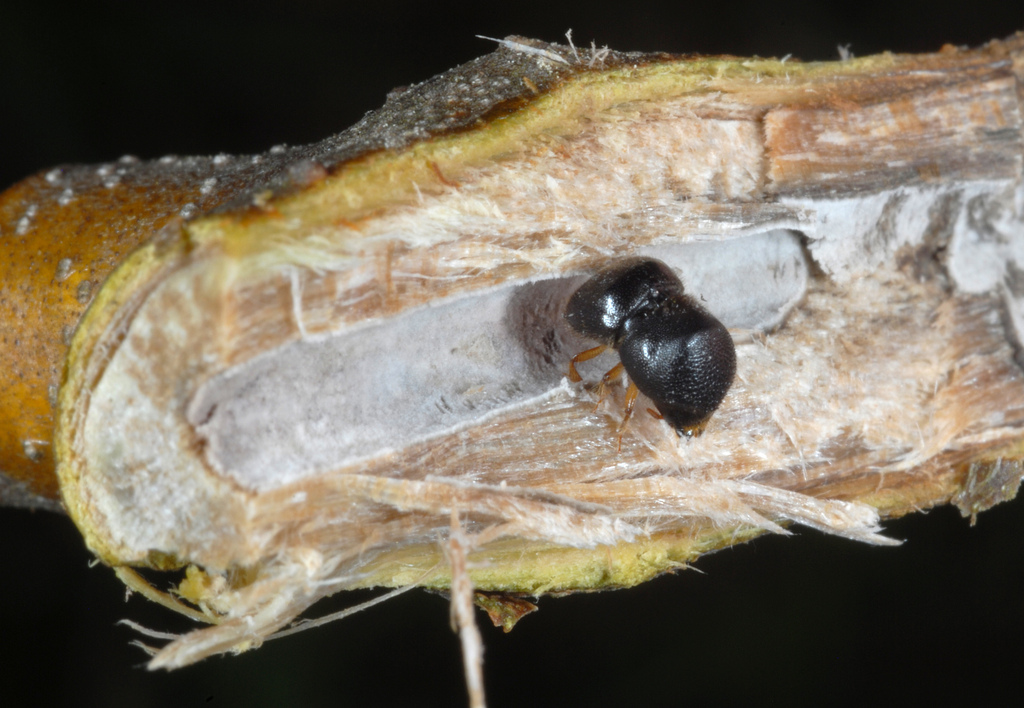
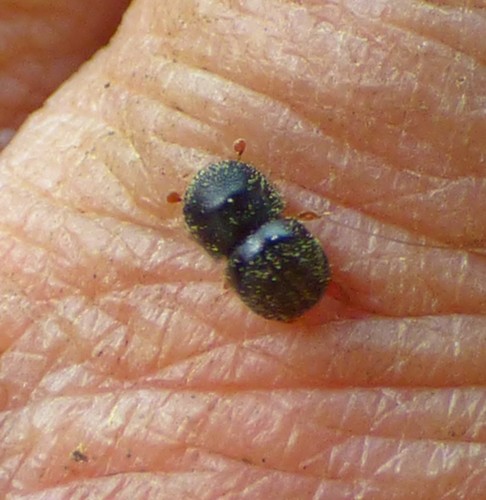
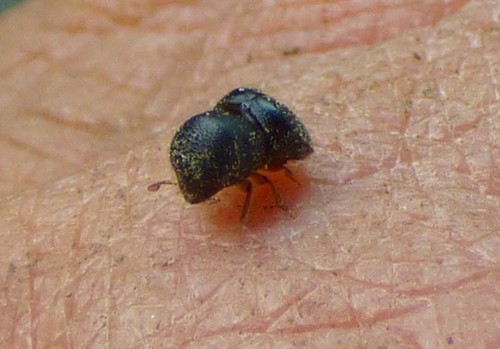
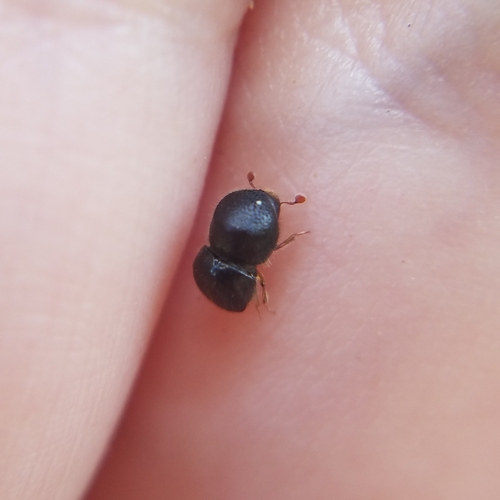
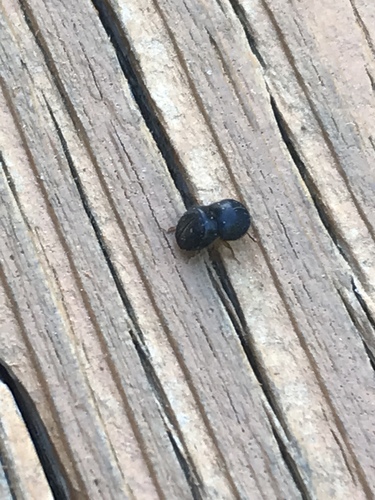
Adult females are large, robust, black beetles about 3.4 to 3.9 mm long and roughly 1.7 times longer than wide. Their bodies are distinctive, with a short abdomen, a sharp slope to the rear, and a “squished” look. They tunnel into plastic fuel containers, making ~2 mm circular holes and can damage gasoline lines in lawnmowers and boats.
Source: Wikipedia
How to recognize it
Females are mainly black, large, and robust compared with most ambrosia beetles. The abdomen is shorter than the head-thorax and the rear slopes sharply, giving a severed appearance.
Source: Wikipedia
What it eats
It farms a symbiotic fungus, Ambrosiella beaveri, which serves as food for both adults and larvae.
Source: Wikipedia
Where it is found in the US
Recorded in 18 of 51 states and DC. Most records: Virginia, Missouri, Louisiana, Florida, North Carolina, Tennessee, Maryland, Kentucky.
Darker = more records. Counts are museum and citizen-science records, not population size.
Source: GBIF
Months it is reported in the US
Source: GBIF
More photos
Questions people ask
How does the Camphor Shot Borer damage my property?
It bores small (~2 mm) circular holes in plastic fuel containers and lines, damaging gasoline storage and equipment.
Source: Wikipedia
Where is this beetle found?
It is native to many Asian countries and has spread throughout the eastern United States.
Source: Wikipedia
Same family (Curculionidae)
 Green Immigrant Leaf WeevilPolydrusus formosusDamages trees, gardens or crops
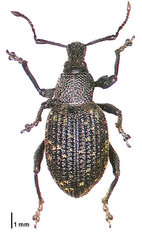 Black Vine WeevilOtiorhynchus sulcatusDamages trees, gardens or crops
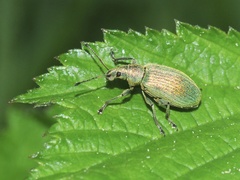 Nettle weevilPhyllobius pomaceusDamages trees, gardens or crops
 Asian Oak WeevilCyrtepistomus castaneusDamages trees, gardens or crops
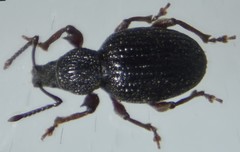 Strawberry Root WeevilOtiorhynchus ovatusDamages trees, gardens or crops
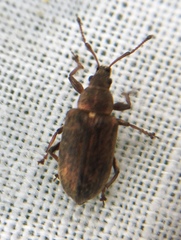 Common Leaf WeevilPhyllobius pyriDamages trees, gardens or crops
Sources
- Wikipedia: https://en.wikipedia.org/wiki/Cnestus_mutilatus
Look it up elsewhere: GBIF · iNaturalist · BugGuide · ITIS · Wikipedia
Text written 2026-10-27 from the sources above and checked sentence by sentence against them. Data fetched 2026-10-27.