 Bug FAQ
Juniper Hairstreak
Callophrys gryneus · Order: Lepidoptera · Family: Lycaenidae
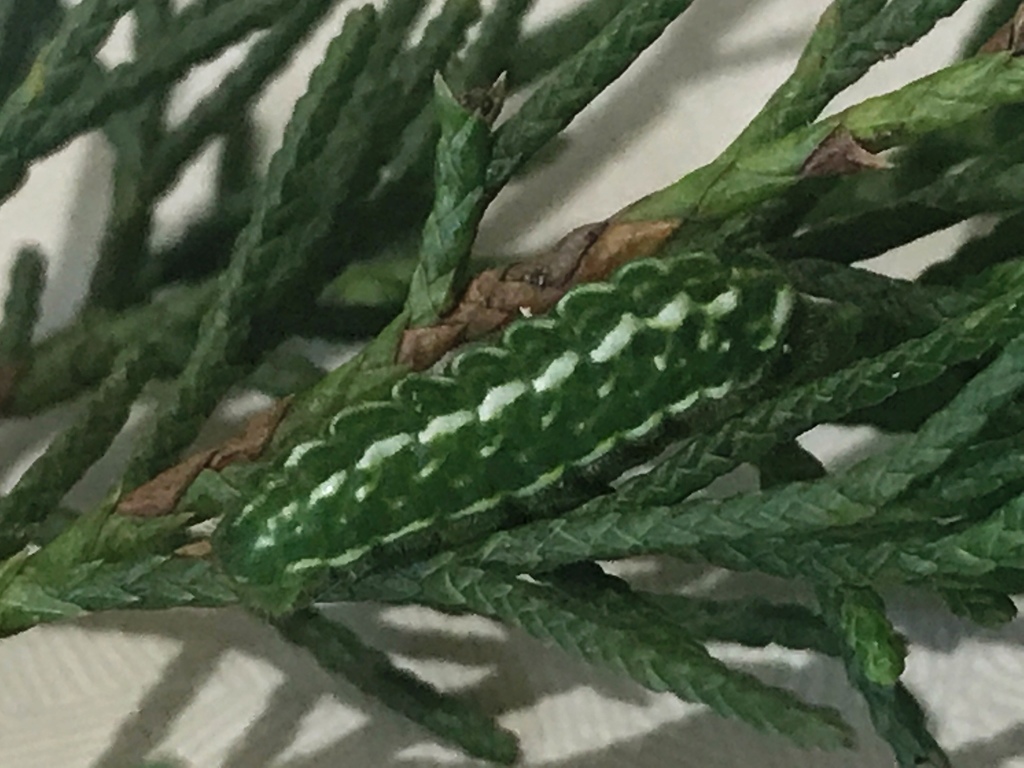
The juniper hairstreak is a North-American butterfly that lives near junipers in open, dry places. Males are orange-bronze on top and defend cedar trees, while females are darker; both sexes have bright green undersides with white spots and a zigzag line. It overwinters as a chrysalis and may have one to three broods per year depending on the race.
Source: Wikipedia
How to recognize it
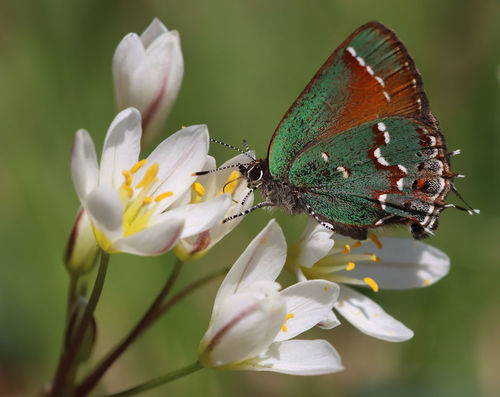
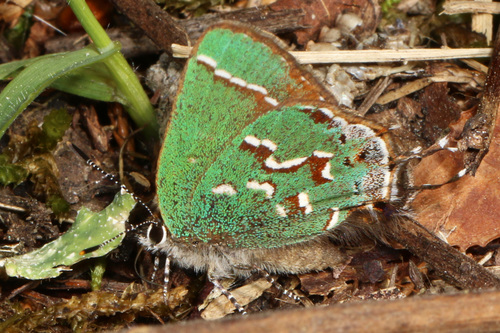
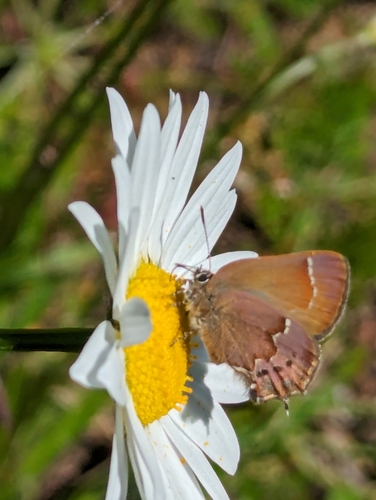
Males have a tawny orange or bronzy upper side, females are blackish brown; the underside is bright green with brown scaling, two white post-basal spots and a white zigzag post-median line edged with brown on the hindwing.
Source: Wikipedia
Where it lives
They are found on bluffs, open fields, barrens, and other dry or rocky open places, almost always near junipers.
Source: Wikipedia
Life cycle
It overwinters as a chrysalis and the number of broods per year varies by race, from one to three.
Source: Wikipedia
When you see it
Males are highly territorial on cedar trees, perching to look for females, and can be coaxed into flight by gently shaking the trees.
Source: Wikipedia
Where it comes from
The species is native to North America.
Source: Wikipedia
Lookalikes
The only similar species in its range is Hessel's hairstreak, and it differs from C. xami by lacking the sharp W mark in the post-median white band.
Source: Wikipedia
Where it is found in the US
Recorded in 48 of 51 states and DC. Most records: Texas, California, Oregon, Arizona, New Mexico, Virginia, Colorado, North Carolina.
Darker = more records. Counts are museum and citizen-science records, not population size.
Source: GBIF
Status: native in North America; native in Canada; native in United States. Source: iNaturalist
Months it is reported in the US
Source: GBIF
More photos

Same family (Lycaenidae)

Sources
- Wikipedia: https://en.wikipedia.org/wiki/Callophrys_gryneus
Look it up elsewhere: GBIF · iNaturalist · BugGuide · ITIS · Wikipedia
Text written 2026-10-22 from the sources above and checked sentence by sentence against them. Data fetched 2026-10-22.