 Bug FAQ
Callippe Fritillary
Speyeria callippe · Order: Lepidoptera · Family: Nymphalidae
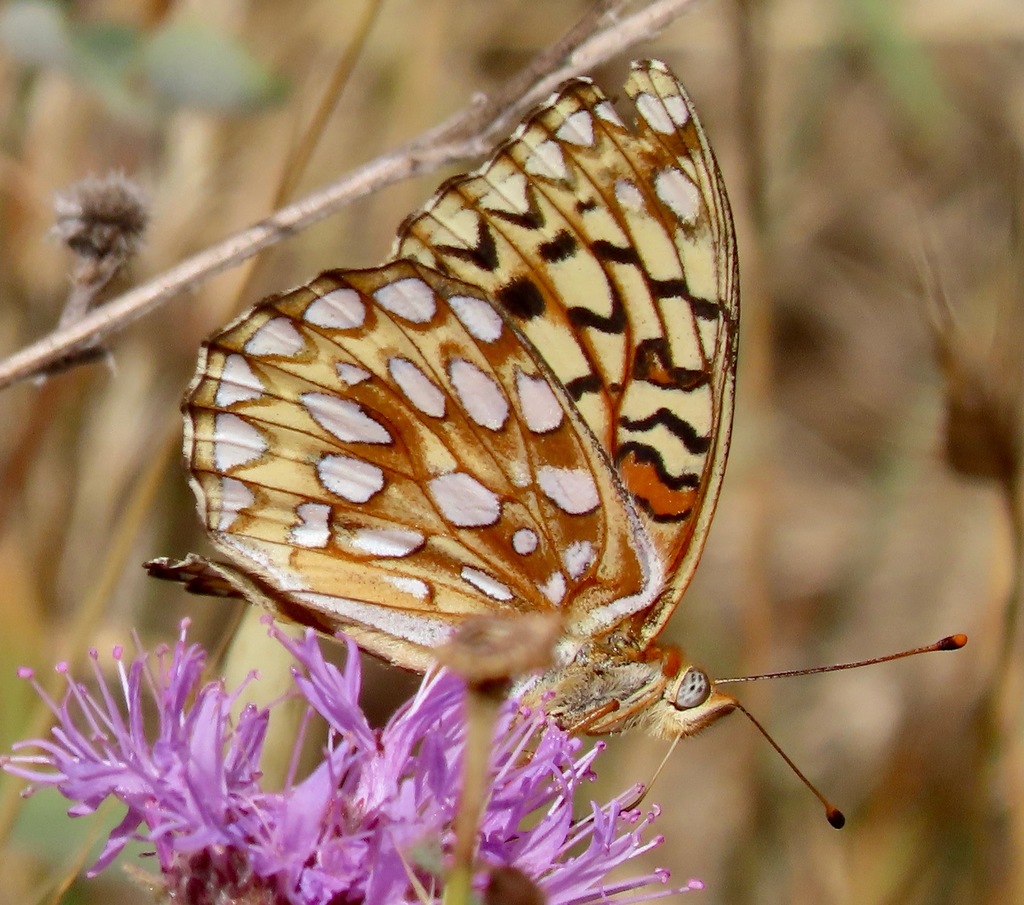
The Callippe fritillary has a wingspan of about 5 to 6.4 cm and its upper wings are tawny to bright red-brown with black zigzag stripes and a black-brown outer edge marked by pale lunules. The species has one generation per year; first-stage caterpillars overwinter and in spring feed on several violet species (Viola pedunculata, V. nuttallii, V. beckwithii, V. douglasii, V. purpurea).
Source: Wikipedia
How to recognize it
Upperside wings range from tawny to bright red-brown with evenly spaced black zigzag stripes. The outer wing contour is black-brown with a row of pale crescent shapes.
Source: Wikipedia
Where it lives
Found in sagebrush, dry woodland, forest edges, chaparral and grassy hillsides.
Source: Wikipedia
What it eats
First-stage caterpillars feed on leaves of several violet species: Viola pedunculata, V. nuttallii, V. beckwithii, V. douglasii and V. purpurea.
Source: Wikipedia
Life cycle
It is univoltine, producing one generation per year. Caterpillars overwinter unfed and resume feeding on violets in spring.
Source: Wikipedia
When you see it
Adults are on the wing from May through August, with females emerging before males.
Source: Wikipedia
Where it is found in the US
Recorded in 13 of 51 states and DC. Most records: California, Idaho, Colorado, Oregon, Wyoming, Utah, Nevada, Montana.
Darker = more records. Counts are museum and citizen-science records, not population size.
Source: GBIF
Months it is reported in the US
Source: GBIF
Questions people ask
When can I see Callippe fritillaries?
Adults fly from May to August, usually with females appearing first.
Source: Wikipedia
What plants do the caterpillars eat?
They feed on leaves of several violet species such as Viola pedunculata and Viola nuttallii.
Source: Wikipedia
Same family (Nymphalidae)






Sources
- Wikipedia: https://en.wikipedia.org/wiki/Speyeria_callippe
Look it up elsewhere: GBIF · iNaturalist · BugGuide · ITIS · Wikipedia
Text written 2026-10-23 from the sources above and checked sentence by sentence against them. Data fetched 2026-10-23.