 Bug FAQ
Cabbage Tree Emperor
Bunaea alcinoe · Order: Lepidoptera · Family: Saturniidae
Also called: Cabbage tree emperor moth

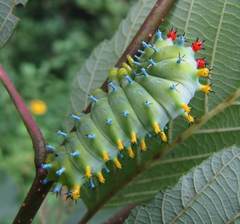
The cabbage tree emperor moth (Bunaea alcinoe) is an African saturniid whose final-instar caterpillar reaches about 70 mm long and 15 mm wide. Its body is deep black with distinctive white or yellow tubercles on most segments and black tubercles on the second and third segments.
Source: Wikipedia
How to recognize it
The caterpillar is deep velvety black; segments 4-12 have eight white or yellow bumps each, while segments 2-3 have four black bumps each plus small yellow bumps on segment 3.
Source: Wikipedia
Size
A fully grown larva is about 70 mm (2.8 in) long and 15 mm (0.59 in) in diameter.
Source: Wikipedia
Where it lives
It lives in Africa and belongs to the Saturniidae family.
Source: Wikipedia
What it eats
Caterpillars feed on plants such as Bauhinia, Croton, Cussonia, Celtis, Harpephyllum afrum and Ekebergia capensis. In the Democratic Republic of the Congo they also eat Sarcocephalus latifolius, Crossopteryx febrifuga and Dacryodes edulis.
Source: Wikipedia
Life cycle
The final instar measures about 70 mm long and 15 mm wide.
Source: Wikipedia
Where it comes from
The species is native to Africa.
Source: Wikipedia
More photos


Same family (Saturniidae)



Sources
- Wikipedia: https://en.wikipedia.org/wiki/Bunaea_alcinoe
Look it up elsewhere: GBIF · iNaturalist · BugGuide · Wikipedia
Text written 2026-10-23 from the sources above and checked sentence by sentence against them. Data fetched 2026-10-23.