 Bug FAQ
Bug flower chafer
Valgus hemipterus · Order: Coleoptera · Family: Scarabaeidae
Also called: Valgus hemipterus
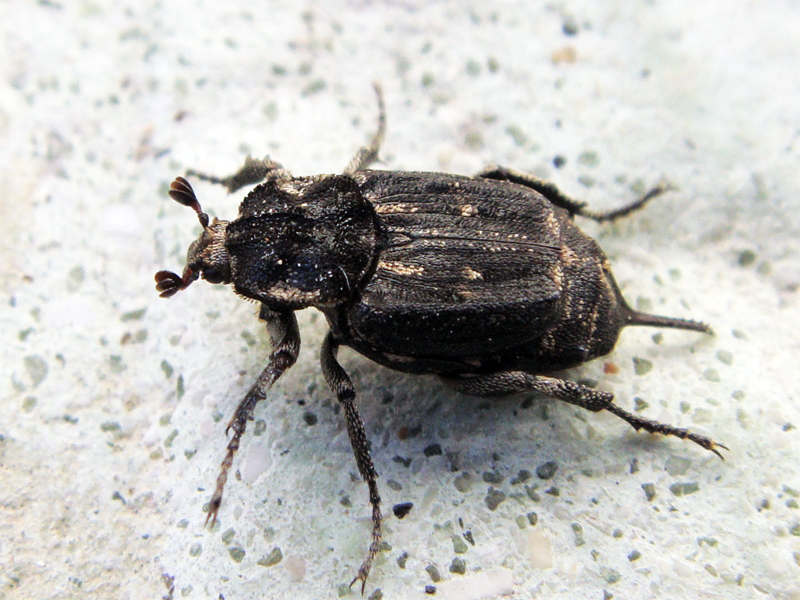
Valgus hemipterus is a small beetle 6 to 10 mm long with a dark body; males have a patterned dark-brown scale while females are uniformly dark-brown. Adults are seen on flowers from early April to August, especially in warm weather, and the larvae develop in the wood of many common trees.
Source: Wikipedia
How to recognize it
The pronotum has a somewhat serrated edge and a rounded base, and the elytra are short, not covering the whole abdomen. Females have a long pointed telson with a central groove and irregular side serrations, which makes them easy to tell apart from males.
Source: Wikipedia
Size
Body length ranges from 6 to 10 mm.
Source: Wikipedia
Where it lives
They live in many places including vineyards and urban areas. Adults visit flowers of various shrubs when it is warm.
Source: Wikipedia
What it eats
Adults are found on flowers or wood from early April to August.
Source: Wikipedia
Life cycle
The species has one generation per year and overwinters as a pupa. Eggs hatch after about 18 days, the second larval stage lasts about 19 days before molting to the third, and pupation lasts roughly 15 days.
Source: Wikipedia
When you see it
Adults appear from early April through August. Mating and egg-laying occur inside dark wood cavities from mid-May to late June. In nature the pupal stage occurs around August.
Source: Wikipedia
Where it comes from
Native from the Caucasus and Turkey through North Africa to southern and central Europe. Introduced to parts of North America such as Ontario, Michigan and Ohio.
Source: Wikipedia
Where it is found in the US
Recorded in 7 of 51 states and DC. Most records: Michigan, Ohio, Illinois, New York, Massachusetts, Indiana, Wisconsin.
Darker = more records. Counts are museum and citizen-science records, not population size.
Source: GBIF
Status: introduced in North America; introduced in United States; introduced in Canada. Source: iNaturalist
Months it is reported in the US
Source: GBIF
More photos


Questions people ask
Can they damage my garden trees?
Yes, the larvae feed on the wood of several common trees, which can harm those plants.
Source: Wikipedia
Where might I find them?
They are common on flowers and in wood in vineyards, urban areas, and other habitats during warm weather.
Source: Wikipedia
Same family (Scarabaeidae)
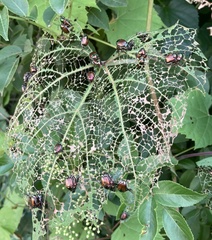 Japanese BeetlePopillia japonicaDamages trees, gardens or crops
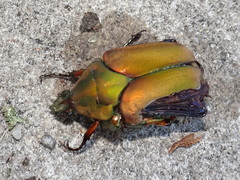 Common Green June BeetleCotinis nitidaDamages trees, gardens or crops
 Phyllophaga crinitaPhyllophaga crinitaDamages trees, gardens or crops
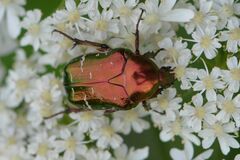 European Rose ChaferCetonia aurata
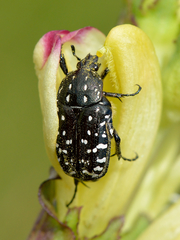 Mediterranean Spotted ChaferOxythyrea funestaDamages trees, gardens or crops
 Oriental BeetleExomala orientalisDamages trees, gardens or crops
Sources
- Wikipedia: https://en.wikipedia.org/wiki/Valgus_hemipterus
Look it up elsewhere: GBIF · iNaturalist · BugGuide · ITIS · Wikipedia
Text written 2026-10-22 from the sources above and checked sentence by sentence against them. Data fetched 2026-10-22.