 Bug FAQ
Brown Argus
Aricia agestis · Order: Lepidoptera · Family: Lycaenidae
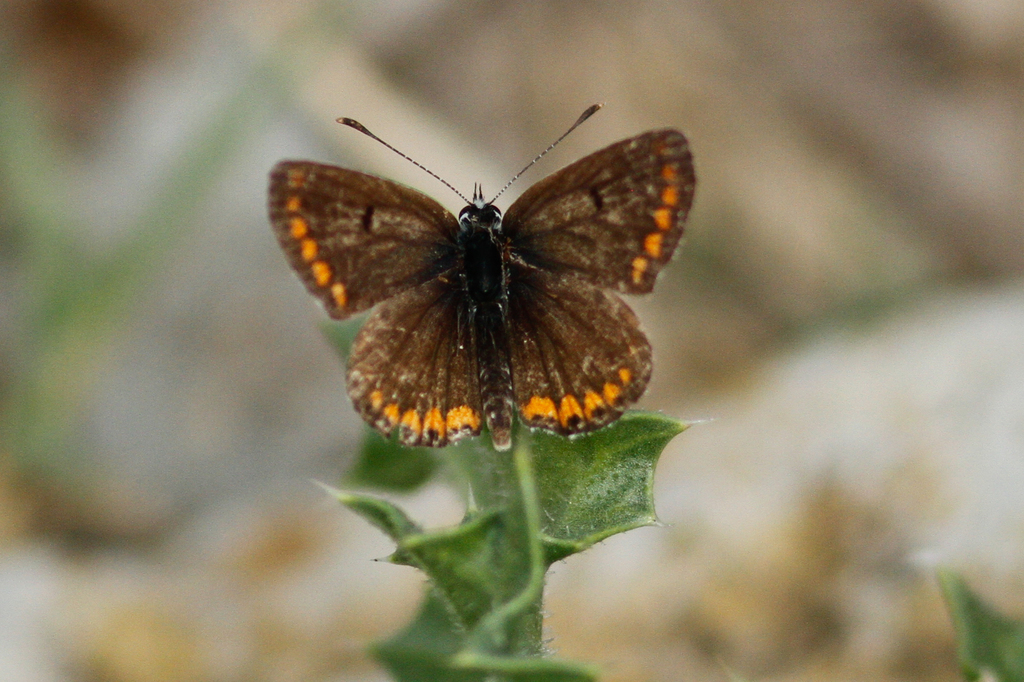
The Brown Argus is a common butterfly with brown upper wings and orange border spots, and a patterned underside with grey-brown ground colour and black spots edged in white. It lives in many open habitats across the Palearctic, especially on chalk downlands, and its caterpillars feed on rock-rose and various geraniums. Adults appear in May and again from July onward, with two generations in the south and one in the north; eggs are pale green and flattened.
Source: Wikipedia
Where it lives
They are found everywhere from fields and garden paths to rocky hills, staying close to the ground. Typical habitats include chalk downlands, woodland clearings, coastal grasslands and heathland.
Source: Wikipedia
What it eats
Caterpillars prefer common rock-rose on calcareous soils. In other areas they also feed on dove's-foot cranesbill, common stork's-bill, and possibly other Geranium species.
Source: Wikipedia
Life cycle
Eggs are pale green, flattened, with a concave top and a finely reticulated surface. Southern populations have two broods (May-June and late July-mid-September); northern ones have one brood in June-July.
Source: Wikipedia
Where it comes from
Their range covers the whole Palearctic, from coastal Wales east to Siberia and the Tian Shan, reaching north to northern Denmark.
Source: Wikipedia
Lookalikes
Unlike other female blues, the Brown Argus lacks blue scales at the wing base. It could be confused with the Northern Brown Argus, but their UK ranges do not overlap.
Source: Wikipedia
Where it is found in the US
Recorded in 2 of 51 states and DC. Most records: Colorado, Pennsylvania.
Darker = more records. Counts are museum and citizen-science records, not population size.
Source: GBIF
Same family (Lycaenidae)





Sources
- Wikipedia: https://en.wikipedia.org/wiki/Aricia_agestis
Look it up elsewhere: GBIF · iNaturalist · BugGuide · Wikipedia
Text written 2026-10-22 from the sources above and checked sentence by sentence against them. Data fetched 2026-10-22.