 Bug FAQ
Broad-bodied Chaser
Libellula depressa · Order: Odonata · Family: Libellulidae
Also called: Broad-Bodied Libellula, Broad-bodied Chaser Dragonfly

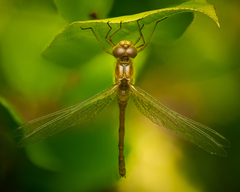
The Broad-bodied Chaser is a medium-large dragonfly about 4 to 5 cm long with a wingspan near 7 cm. It has a very broad, flattened abdomen with brown and yellow side patches, dark wing bases, and the male’s abdomen turns a powdery blue. It lives around still-water lakes and ponds, often being one of the first species to appear at new or sunny water bodies, and flies from April to September, most commonly in May-June.
Source: Wikipedia
How to recognize it
The abdomen is unusually broad and flattened, with brown colour and yellow side patches; males develop a pruinose blue abdomen. Both fore and hind wings show a dark patch at their bases.
Source: Wikipedia
Size
Body length ranges from about 39 to 48 mm. Wingspan is roughly 70 mm.
Source: Wikipedia
Where it lives
Prefers bare, sunny spots and quickly colonises new or well-vegetated ponds.
Source: Wikipedia
What it eats
Feeds on a variety of small insects near still water.
Source: Wikipedia
Life cycle
Eggs hatch after four to five weeks; larvae develop for one to two years. New adults leave the water and mature for 10 to 14 days before they are seen flying.
Source: Wikipedia
When you see it
Adults are on the wing from April through September, with peak numbers in May and June.
Source: Wikipedia
Where it comes from
Its range extends north into England, Wales, southern Scotland, southern Sweden and southern Finland.
Source: Wikipedia
Lookalikes
It is very distinctive and rarely confused with other dragonflies in its range.
Source: Wikipedia
More photos


Same family (Libellulidae)

Sources
- Wikipedia: https://en.wikipedia.org/wiki/Libellula_depressa
Look it up elsewhere: GBIF · iNaturalist · BugGuide · Wikipedia
Text written 2026-10-22 from the sources above and checked sentence by sentence against them. Data fetched 2026-10-22.