 Bug FAQ
Botany Bay Diamond Weevil
Chrysolopus spectabilis · Order: Coleoptera · Family: Curculionidae
Source: Wikipedia

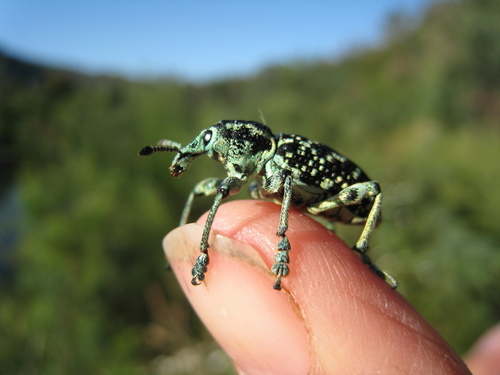
The diamond weevil is an elongated oval beetle about 15 to 25 mm long with black elytra spotted in bright metallic green. Adults are active day and night in warm months, especially near Acacia plants, and they feed on several Acacia species, boring holes to reach sap and lay eggs. In southeastern Australia it can become a pest, destroying new shoots and reducing water uptake of Acacia trees.
Source: Wikipedia
How to recognize it
The wing covers are black with irregular bright metallic-green spots, and the underside is matte green with a white or green line along the sides.
Source: Wikipedia
Size
The body measures about 15 to 25 mm (0.6 to 1.0 in) long.
Source: Wikipedia
Is it a pest in the house?
In southeastern Australia it can become a pest of Acacia plantations, destroying new shoots and limiting the plant’s water uptake.
Source: Wikipedia
Does it bite or sting?
Despite its bright colours, it is not poisonous and will either play dead or cling tightly to the plant when threatened.
Source: Wikipedia
What it eats
It feeds almost exclusively on certain Acacia species such as Cootamundra wattle, silver wattle, Australian blackwood and golden wattle. It uses its long snout and strong mouthparts to bore holes in stems and leaves to reach sap and to create egg chambers.
Source: Wikipedia
Life cycle
Development from egg to adult usually takes less than a year. Females make up to 20 small holes just above soil level in the stem and lay one egg in each.
Source: Wikipedia
When you see it
Adults are active in the warm months (November to March) and emerge in spring in southern areas, but can appear year-round in subtropical zones.
Source: Wikipedia
Where it comes from
It occurs in eastern and southern Australia, from coastal Queensland down to Victoria and eastern South Australia. The species was first described from specimens collected on James Cook’s first voyage.
Source: Wikipedia
Lookalikes
The name “diamond weevil” was coined in 1805 because its colouration resembles that of the Brazilian “diamond beetle”, though the two are not closely related.
Source: Wikipedia
More photos
Questions people ask
How can I identify a Botany Bay diamond weevil?
Look for a 15 to 25 mm oval beetle with black elytra spotted in bright metallic green and a matte-green underside with a white or green side line.
Source: Wikipedia
What trees do they damage?
They damage various Acacia species, especially in plantations, by destroying new shoots and reducing water uptake.
Source: Wikipedia
When are they most active?
They are active day and night during the warm months from November to March, emerging in spring in southern areas.
Source: Wikipedia
Same family (Curculionidae)
 Green Immigrant Leaf WeevilPolydrusus formosusDamages trees, gardens or crops
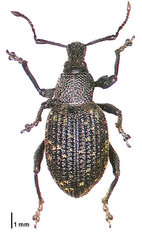 Black Vine WeevilOtiorhynchus sulcatusDamages trees, gardens or crops
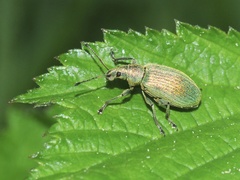 Nettle weevilPhyllobius pomaceusDamages trees, gardens or crops
 Asian Oak WeevilCyrtepistomus castaneusDamages trees, gardens or crops
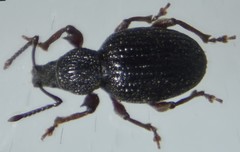 Strawberry Root WeevilOtiorhynchus ovatusDamages trees, gardens or crops
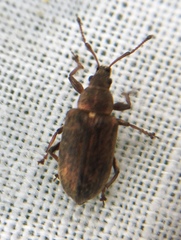 Common Leaf WeevilPhyllobius pyriDamages trees, gardens or crops
Sources
- Wikipedia: https://en.wikipedia.org/wiki/Chrysolopus_spectabilis
Look it up elsewhere: GBIF · iNaturalist · BugGuide · Wikipedia
Text written 2026-10-23 from the sources above and checked sentence by sentence against them. Data fetched 2026-10-22.