 Bug FAQ
Bohemian Cuckoo Bumble bee
Bombus bohemicus · Order: Hymenoptera · Family: Apidae
Also called: Bohemian Cuckoo Bee, Gipsy Cuckoo-bee, Gypsy (Bohemian) Cuckoo Bee, Gypsy Cuckoo Bee
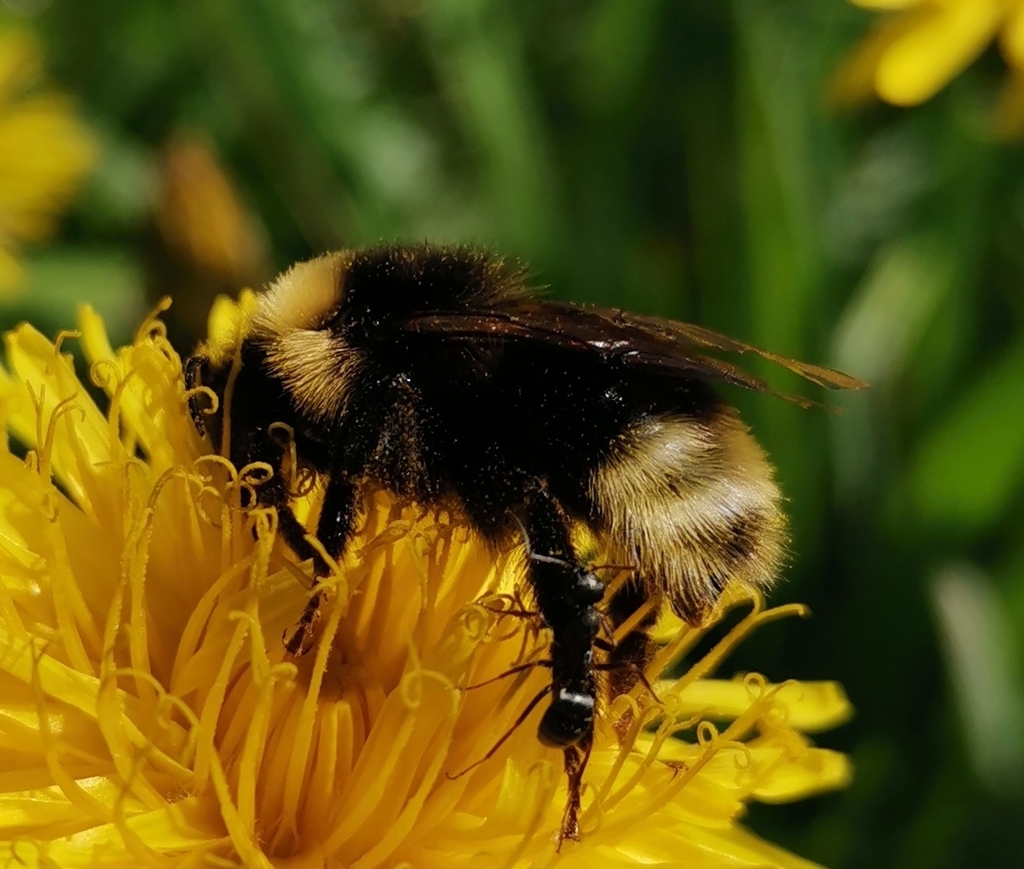
Queens are 15 to 20 mm long with a round face, black head hair, a pale yellow collar, and a mostly black abdomen with yellow and white markings. They are socially parasitic, invading nests of B. locurum, B. cryptarum, or B. terrestris and using the host workers to raise their own brood.
Source: Wikipedia
How to recognize it
The face and head have black hair with a pale yellow collar that lacks black hairs, and the abdomen is mainly black with yellow hairs on the first segment, pale yellow sides on the third, and a white or pale yellow tail.
Source: Wikipedia
Size
Queens measure about 15 to 20 mm, while males are smaller at 11 to 17 mm.
Source: Wikipedia
Is it a pest in the house?
It does not build nests but takes over newly established host nests, usurping the host queen. Its hosts are B. locurum, B. cryptarum, and B. terrestris.
Source: Wikipedia
Does it bite or sting?
Females have thick cuticles, larger venom sacs, and more powerful stings than their hosts; males lack a sting.
Source: Wikipedia
Where it lives
It lives in temperate regions, sharing the same habitats as its host bees and prefers to forage among scrub-type flowering plants.
Source: Wikipedia
Life cycle
After invading a host nest, the cuckoo queen eventually lays her own eggs.
Source: Wikipedia
When you see it
It is one of the most common cuckoo bumblebees in Europe.
Source: Wikipedia
Where it comes from
The species occurs throughout most of Europe except southern Iberia and Iceland, and it is also found in Turkey.
Source: Wikipedia
Lookalikes
Unlike normal bumblebees, it lacks pollen sacks on its hind legs, which are instead covered in dense hair.
Source: Wikipedia
Where it is found in the US
Recorded in 10 of 51 states and DC. Most records: Alaska, Utah, Pennsylvania, Michigan, Ohio, Maine, Wisconsin, Illinois.
Darker = more records. Counts are museum and citizen-science records, not population size.
Source: GBIF
Status: native in Canada. Source: iNaturalist
Months it is reported in the US
Source: GBIF
More photos

Questions people ask
Do female Bohemian cuckoo bumblebees sting?
Yes, females have strong stings, while males are stingless.
Source: Wikipedia
What plants do they visit for nectar?
They forage on nectar from scrub-type flowering plants.
Source: Wikipedia
Which bumblebee species do they parasitize?
They parasitize B. locurum, B. cryptarum, and B. terrestris.
Source: Wikipedia
Where can I find Bohemian cuckoo bumblebees?
They are common throughout most of Europe (except southern Iberia and Iceland) and also occur in Turkey.
Source: Wikipedia
Same family (Apidae)





Sources
- Wikipedia: https://en.wikipedia.org/wiki/Bombus_bohemicus
Look it up elsewhere: GBIF · iNaturalist · BugGuide · ITIS · Wikipedia
Text written 2026-10-22 from the sources above and checked sentence by sentence against them. Data fetched 2026-10-22.