 Bug FAQ
Boas Rhinoceros Beetle
Oryctes boas · Order: Coleoptera · Family: Scarabaeidae
Also called: African Rhinoceros Beetle
Source: Wikipedia
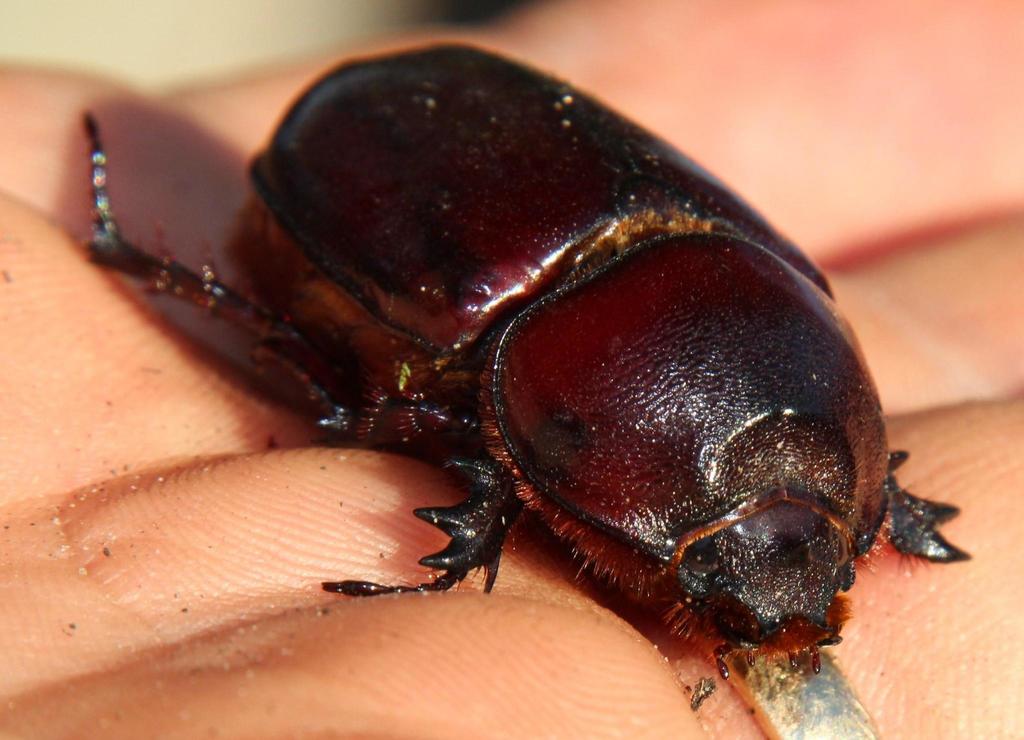
Adults are 27 to 46 mm long, glossy dark reddish-brown, and males have a long backward-curved horn with a deep pronotum depression. The beetle breeds in compost heaps and is a common pest of coconut palms in south-eastern Africa, where it bores from leaf axils into the palm crown.
Source: Wikipedia
How to recognize it
Males have a very long, backward-curved horn and a pronotum with a large depression and two separated pointed teeth. Females have a short horn and a small, round pronotum depression usually with two close-together knobs. Both sexes are glossy dark reddish-brown.
Source: Wikipedia
Size
Adults measure between about 30 and 40 mm, with examined specimens ranging from 27 to 46 mm.
Source: Wikipedia
How to get rid of it
A related nudivirus can infect Oryctes species and may be useful for control. The assassin bug Platymeris rhadamanthus is often found with dead Oryctes adults in coconut leaf axils.
Source: Wikipedia
Where it lives
It breeds mainly in compost heaps and is most common in south-eastern Africa.
Source: Wikipedia
What it eats
The beetle feeds on undeveloped palm fronds.
Source: Wikipedia
Life cycle
It is a known pest of coconut palms, damaging the plant as it develops. Natural enemies have been studied for possible biological control.
Source: Wikipedia
Where it comes from
It is found throughout sub-Saharan Africa and parts of the Near East.
Source: Wikipedia
Lookalikes
It is smaller and more heavily built than O. monoceros, and both share three fixed spikes on the hind tibia.
Source: Wikipedia
More photos

Questions people ask
How can I tell male from female Boas Rhinoceros Beetles?
Males have a long backward-curved horn and a deep pronotum depression with two separated teeth, while females have a short horn and a small round depression with two close knobs.
Source: Wikipedia
What damage does this beetle cause to coconut palms?
It bores from the leaf axil into the palm crown, damaging the palm heart where new fronds grow.
Source: Wikipedia
Where is the Boas Rhinoceros Beetle found?
It occurs across sub-Saharan Africa and parts of the Near East, especially in south-eastern Africa.
Source: Wikipedia
Can I use biological control against this beetle?
Studies have looked at natural enemies and a related nudivirus that can infect Oryctes species as possible biocontrol agents.
Source: Wikipedia
Same family (Scarabaeidae)
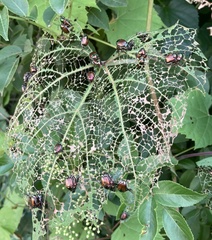 Japanese BeetlePopillia japonicaDamages trees, gardens or crops
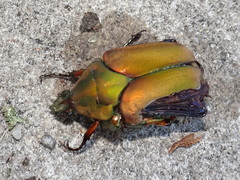 Common Green June BeetleCotinis nitidaDamages trees, gardens or crops
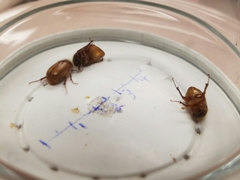 Phyllophaga crinitaPhyllophaga crinitaDamages trees, gardens or crops
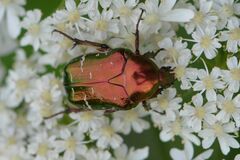 European Rose ChaferCetonia aurata
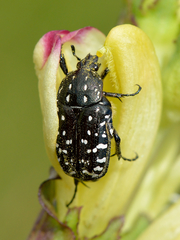 Mediterranean Spotted ChaferOxythyrea funestaDamages trees, gardens or crops
 Oriental BeetleExomala orientalisDamages trees, gardens or crops
Sources
- Wikipedia: https://en.wikipedia.org/wiki/Oryctes_boas
Look it up elsewhere: GBIF · iNaturalist · BugGuide · Wikipedia
Text written 2026-10-23 from the sources above and checked sentence by sentence against them. Data fetched 2026-10-23.