 Bug FAQ
Blue-spot Pansy
Junonia oenone · Order: Lepidoptera · Family: Nymphalidae
Also called: Dark Blue Pansy
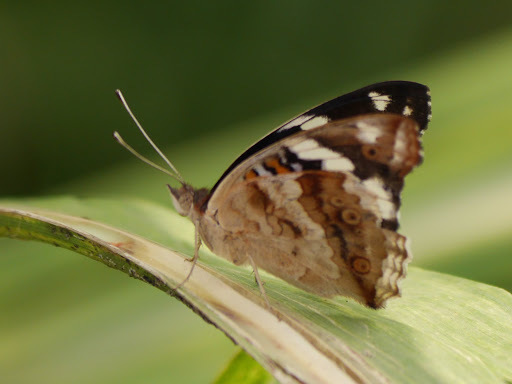
The blue-spot pansy has a wingspan of about 40 to 52 mm. Its forewings are black with white markings near the tips, and the hindwings are black with white edging and a large metallic-blue spot. It is a Nymphalid butterfly native to Africa and its larvae feed on a variety of plants such as Adhatoda, Mackaya, Justicia, Asystasia, Isoglossa and related species.
Source: Wikipedia
How to recognize it
Upper forewings are black with white markings toward the apex.
Source: Wikipedia
Size
Wingspan ranges from 40 to 52 mm.
Source: Wikipedia
Where it lives
It is a Nymphalid butterfly native to Africa.
Source: Wikipedia
What it eats
Larvae feed on plants including Adhatoda densiflora, Mackaya bella, Justicia natalensis, Asystasia species, Isoglossa, Pualowilhelmia and Ruella.
Source: Wikipedia
Where it comes from
Its native range is Africa.
Source: Wikipedia
Lookalikes
In India, the name "blue pansy" can also refer to Junonia orithya.
Source: Wikipedia
Same family (Nymphalidae)






Sources
- Wikipedia: https://en.wikipedia.org/wiki/Junonia_oenone
Look it up elsewhere: GBIF · iNaturalist · BugGuide · Wikipedia
Text written 2026-10-22 from the sources above and checked sentence by sentence against them. Data fetched 2026-10-22.