 Bug FAQ
Blue Admiral
Kaniska canace · Order: Lepidoptera · Family: Nymphalidae
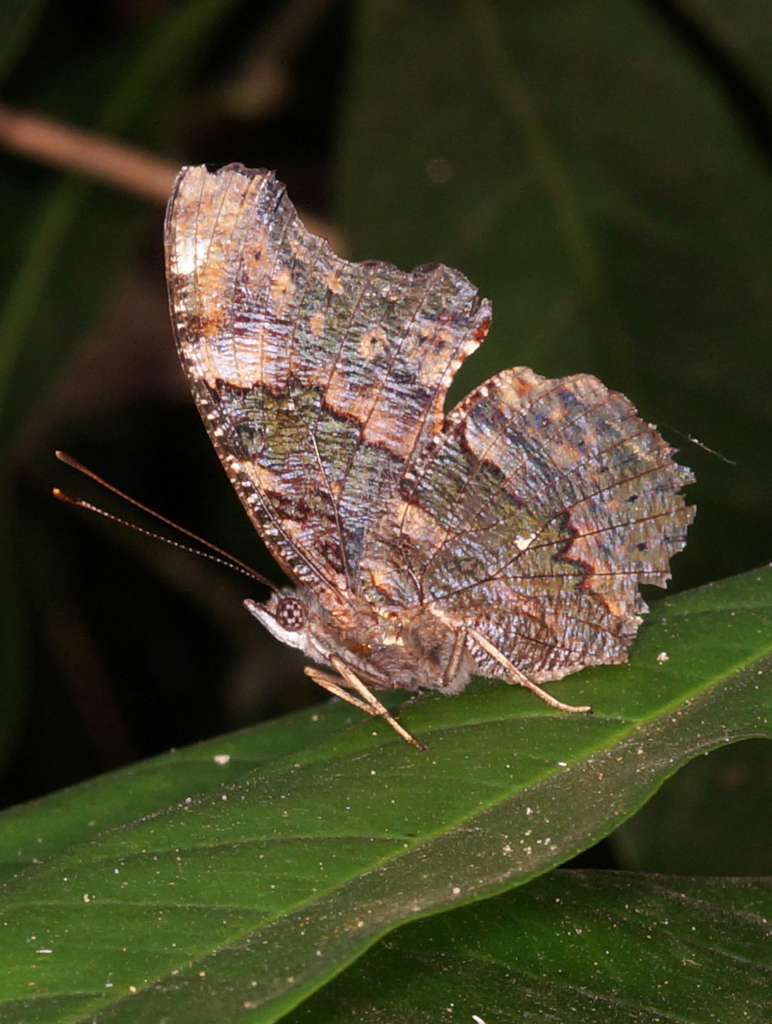
The Blue Admiral has a wingspan of about 60 to 70 mm and displays black upper wings with distinctive blue markings on both fore- and hindwings. It lives in South and Southeast Asia, ranging from southeastern Siberia to Indonesia, and is highly territorial, often defending perches.
Source: Wikipedia
How to recognize it
Upper side of both fore- and hindwings is black; the underside is black and brown. Forewings have a wavy blue band near the outer edge, a blue or white spot near the leading edge, and a small white spot at the tip. Hindwings feature a wide blue transverse band, a row of tiny black spots, and a narrow wavy blue edge.
Source: Wikipedia
Size
Wingspan measures roughly 60 to 70 mm (2.4 to 2.8 in).
Source: Wikipedia
Where it lives
The species is very territorial and will chase away other butterflies that enter its area. It perches on defined spots, often basking with wings open or half-open.
Source: Wikipedia
What it eats
Caterpillars feed on various Smilacaceae (e.g., Smilax species) and some Liliaceae plants such as Streptopus, Tricyrtis and Lilium.
Source: Wikipedia
Life cycle
The nominate subspecies K. c. canace has orange-white segmented larvae with black spots and spines, and a variegated reddish-brown pupa with gold and silver frontal spots.
Source: Wikipedia
Lookalikes
Subspecies K. c. haronica looks similar but may show greenish shading at wing bases and a discal blue band that connects to an oblique bar, unlike the typical form.
Source: Wikipedia
Questions people ask
What plants do the caterpillars eat?
The larvae feed on several Smilax species and some lilies and related plants.
Source: Wikipedia
Same family (Nymphalidae)






Sources
- Wikipedia: https://en.wikipedia.org/wiki/Kaniska_canace
Look it up elsewhere: GBIF · iNaturalist · BugGuide · Wikipedia
Text written 2026-10-22 from the sources above and checked sentence by sentence against them. Data fetched 2026-10-22.