 Bug FAQ
Blood-red Acraea
Rubraea petraea · Order: Lepidoptera · Family: Nymphalidae
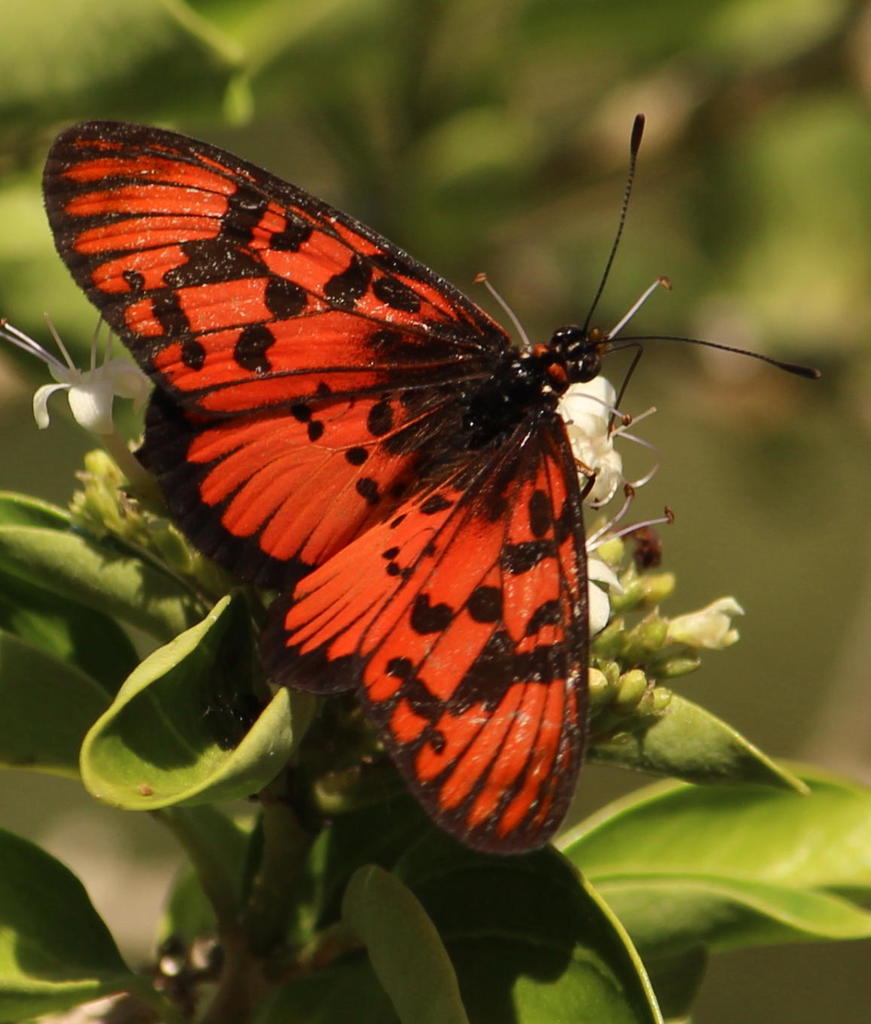
The Blood-red Acraea has bright red to orange-yellow wings with strong black markings; females show a broad white sub-apical band on the forewing and a darker ground colour. It lives in coastal forests of eastern Africa from KwaZulu-Natal through Mozambique, Kenya and Malawi, and adults can be seen all year, especially from November to February.
Source: Wikipedia
How to recognize it
The upper side of the wings is bright red to orange-yellow with prominent black markings. Females have a wide white or whitish band near the tip of the forewing and often a darker, reddish-grey to black-grey ground colour, especially on the forewing.
Source: Wikipedia
Size
Males have a wingspan of about 45 to 48 mm, while females range from 45 to 55 mm.
Source: Wikipedia
Where it lives
It inhabits coastal forest areas.
Source: Wikipedia
What it eats
Caterpillars feed on the plants Xylotheca kraussiana and Xylotheca kotzei.
Source: Wikipedia
Life cycle
The larva is gold-brown with black lines and spines, has a black head with a white angled spot, and lives on Oncoba kraussiana.
Source: Wikipedia
When you see it
Adults are on the wing throughout the year, with a peak from November to February.
Source: Wikipedia
Lookalikes
It can be confused with Acraea atolmis, but can be distinguished by the sub-marginal dots on the forewing. Acraea rohlfsi is an extreme form of this species; it differs by having a narrower marginal band on the hindwing that is indistinct on the underside.
Source: Wikipedia
Same family (Nymphalidae)






Sources
- Wikipedia: https://en.wikipedia.org/wiki/Acraea_petraea
Look it up elsewhere: GBIF · iNaturalist · BugGuide · Wikipedia
Text written 2026-10-24 from the sources above and checked sentence by sentence against them. Data fetched 2026-10-24.