 Bug FAQ
Black Stem Borer
Xyleborus germanus · Order: Coleoptera · Family: Curculionidae

The black stem borer attacks woody ornamental trees and orchard crops, especially apples and pecan. It is native to eastern Asia but has spread to temperate regions worldwide, moving several tens of kilometres each year, often via transport of infested wood.
Source: Wikipedia
How to recognize it
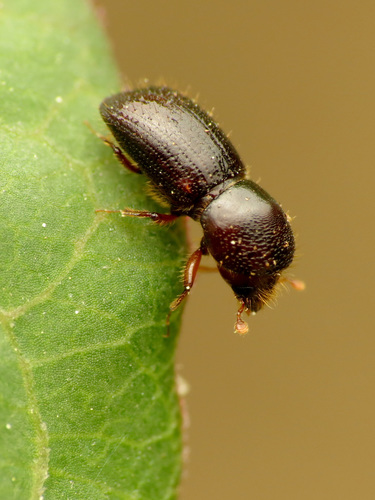
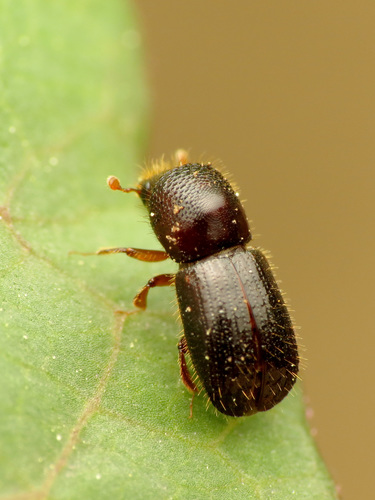
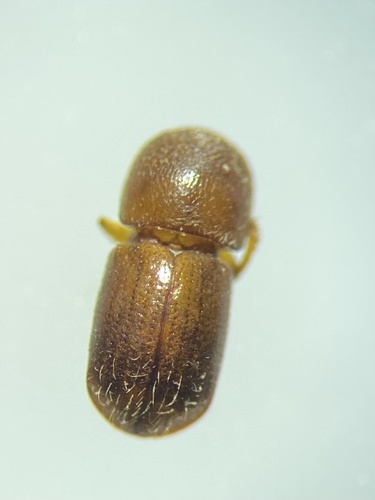
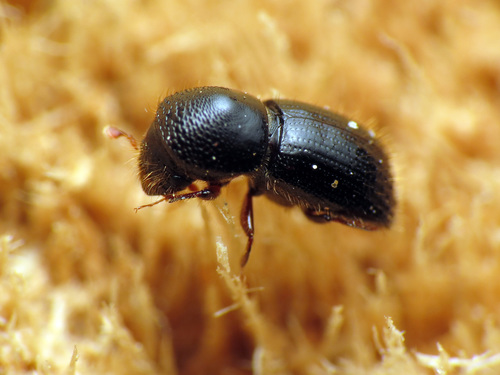
Adult females are about 2.3 times longer than they are wide. Males are seldom seen outside the galleries they create in wood.
Source: Wikipedia
Size
Females grow up to roughly 2 mm long. Males are smaller, about 1.3 to 1.8 mm long and about twice as wide as they are long.
Source: Wikipedia
Is it a pest in the house?
It is a problem for woody ornamental plants and orchard crops like apples and pecan.
Source: Wikipedia
How to get rid of it
In the United States it spreads at a rate of several tens of kilometres per year. Human movement of infested wood is a major way it travels long distances.
Source: Wikipedia
Where it lives
It lives in temperate climates, both where it is native and where it has been introduced.
Source: Wikipedia
What it eats
Both adults and larvae feed on a cultivated ambrosia fungus, Ambrosiella grosmanniae.
Source: Wikipedia
Life cycle
Development from egg to adult takes about 30 days and includes three larval instars. Adults gather in galleries inside tree trunks during winter for protection.
Source: Wikipedia
When you see it
First adults emerge in spring after about 75 growing-degree days (base 50 °F). Emergence usually occurs within a few days of the full bloom of certain trees such as Cornelian cherry dogwood, Norway maple, and border forsythia.
Source: Wikipedia
Where it comes from
The species originates from eastern Asia.
Source: Wikipedia
Where it is found in the US
Recorded in 15 of 51 states and DC. Most records: Pennsylvania, Delaware, Illinois, Massachusetts, Michigan, Georgia, New York, Tennessee.
Darker = more records. Counts are museum and citizen-science records, not population size.
Source: GBIF
Status: introduced in Canada. Source: iNaturalist
Months it is reported in the US
Source: GBIF
More photos
Questions people ask
How does the black stem borer spread to new areas?
People moving infested wood can carry it far beyond its current range.
Source: Wikipedia
What trees and crops are affected?
It attacks woody ornamentals and orchard trees, especially apples and pecan.
Source: Wikipedia
When do the adults first appear each year?
Adults emerge in spring after about 75 growing-degree days (base 50 °F).
Source: Wikipedia
How long does it take to develop from egg to adult?
The full life cycle takes roughly 30 days, passing through three larval stages.
Source: Wikipedia
Same family (Curculionidae)
 Green Immigrant Leaf WeevilPolydrusus formosusDamages trees, gardens or crops
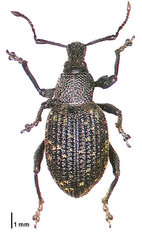 Black Vine WeevilOtiorhynchus sulcatusDamages trees, gardens or crops
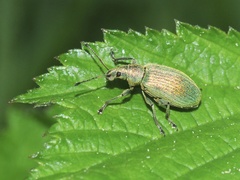 Nettle weevilPhyllobius pomaceusDamages trees, gardens or crops
 Asian Oak WeevilCyrtepistomus castaneusDamages trees, gardens or crops
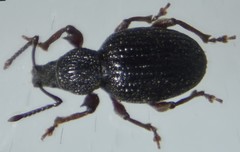 Strawberry Root WeevilOtiorhynchus ovatusDamages trees, gardens or crops
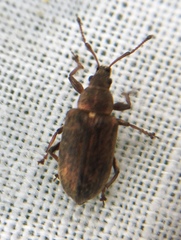 Common Leaf WeevilPhyllobius pyriDamages trees, gardens or crops
Sources
- Wikipedia: https://en.wikipedia.org/wiki/Xylosandrus_germanus
Look it up elsewhere: GBIF · iNaturalist · BugGuide · ITIS · Wikipedia
Text written 2026-10-24 from the sources above and checked sentence by sentence against them. Data fetched 2026-10-24.