 Bug FAQ
Black plant bug
Capsus ater · Order: Hemiptera · Family: Miridae

Capsus ater, called the black plant bug, belongs to the Miridae family. It lives in dry to moderately moist open or partly shaded places and can be found above 2000 m in the Alps. The species likely originated in North America but now occurs throughout Europe, the Palearctic to Siberia, and North America.
Source: Wikipedia
How to recognize it
Capsus ater is the scientific name for the black plant bug, a member of the Miridae family.
Source: Wikipedia
Where it lives
It prefers dry to moderately moist habitats that are open or partly shaded. In the Alps it can be found at elevations over 2000 m.
Source: Wikipedia
Where it comes from
The bug likely originated in North America. It is now present in Europe, across the Palearctic to Siberia, and throughout North America.
Source: Wikipedia
Where it is found in the US
Recorded in 15 of 51 states and DC. Most records: Illinois, Massachusetts, New York, Pennsylvania, Wisconsin, Colorado, Iowa, Maine.
Darker = more records. Counts are museum and citizen-science records, not population size.
Source: GBIF
Status: introduced in Canada. Source: iNaturalist
Months it is reported in the US
Source: GBIF
Same family (Miridae)
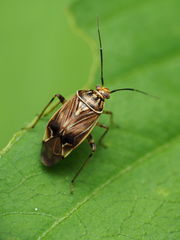 North American Tarnished Plant BugLygus lineolarisDamages trees, gardens or crops
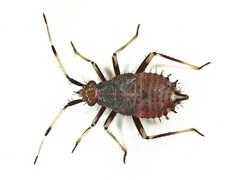 Red-spotted Plant BugDeraeocoris ruber
 Alfalfa Plant BugAdelphocoris lineolatusDamages trees, gardens or crops
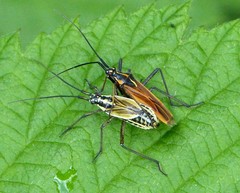 Meadow Plant BugLeptopterna dolabrataDamages trees, gardens or crops
 Four-lined Plant BugPoecilocapsus lineatusDamages trees, gardens or crops
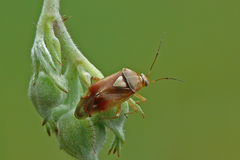 Lygus pratensisLygus pratensisDamages trees, gardens or crops
Sources
- Wikipedia: https://en.wikipedia.org/wiki/Capsus_ater
Look it up elsewhere: GBIF · iNaturalist · BugGuide · ITIS · Wikipedia
Text written 2026-10-23 from the sources above and checked sentence by sentence against them. Data fetched 2026-10-22.