 Bug FAQ
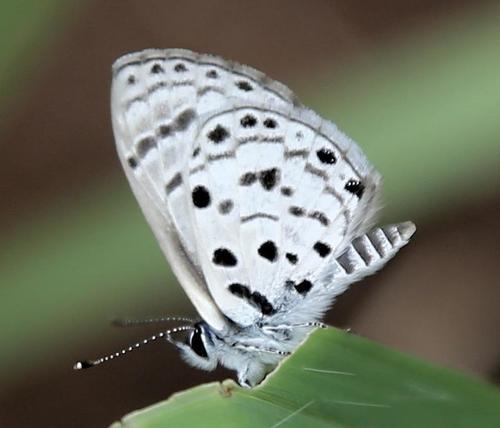
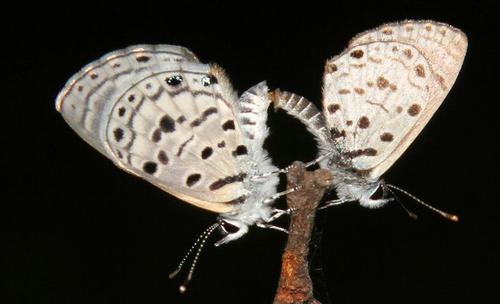
Black-bordered Babul Blue
Azanus moriqua · Order: Lepidoptera · Family: Lycaenidae
Also called: Thorn-tree Babul Blue, Thorn-tree Blue

The black-bordered babul blue is a small Lycaenid butterfly with a wingspan of about 19 to 25 mm. It lives throughout the Afrotropical realm and its caterpillars feed on Acacia species. Adults fly year-round, but are most common from September through May.
Source: Wikipedia
How to recognize it
The black-bordered babul blue belongs to the butterfly family Lycaenidae.
Source: Wikipedia
Size
Males measure 19 to 24 mm in wingspan, while females measure 19 to 25 mm.
Source: Wikipedia
Where it lives
It inhabits the Afrotropical region.
Source: Wikipedia
What it eats
The larvae feed on leaves of Acacia species.
Source: Wikipedia
Life cycle
Adults are on the wing throughout the year, with a peak from September to May.
Source: Wikipedia
When you see it
Their flight period is mainly between September and May, though they can be seen year-round.
Source: Wikipedia
Where it comes from
Its native range is the Afrotropical realm.
Source: Wikipedia
More photos
Questions people ask
When are black-bordered babul blues most active?
They are most commonly seen flying from September through May, but can be observed all year.
Source: Wikipedia
How big are these butterflies?
Males have a wingspan of 19 to 24 mm and females 19 to 25 mm.
Source: Wikipedia
Where can I find black-bordered babul blues?
They occur throughout the Afrotropical realm.
Source: Wikipedia
Same family (Lycaenidae)

Sources
- Wikipedia: https://en.wikipedia.org/wiki/Azanus_moriqua
Look it up elsewhere: GBIF · iNaturalist · BugGuide · Wikipedia
Text written 2026-10-23 from the sources above and checked sentence by sentence against them. Data fetched 2026-10-23.