 Bug FAQ
Belted Orchid bee
Eulaema cingulata · Order: Hymenoptera · Family: Apidae
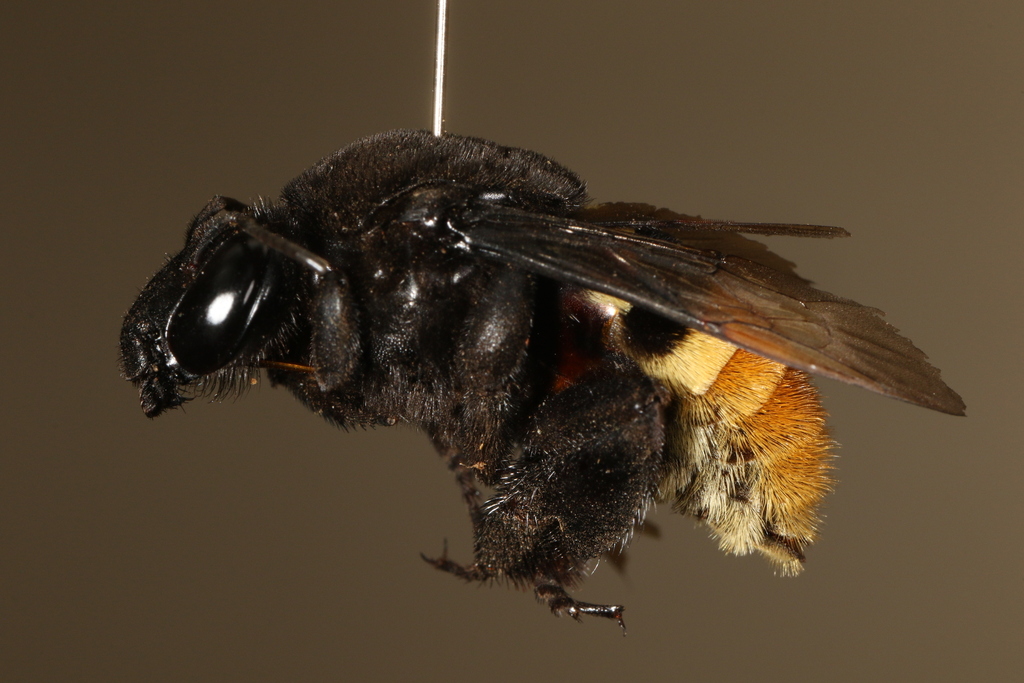
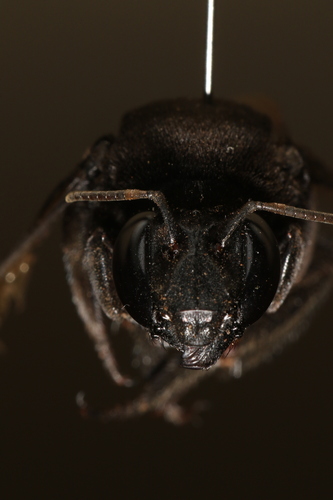
The Belted Orchid bee is a large black and orange bee with bright orange segments on its abdomen and white facial markings. It lives from Mexico to Brazil, can be found up to 2500 m elevation, and often appears in disturbed areas.
Source: Wikipedia
How to recognize it
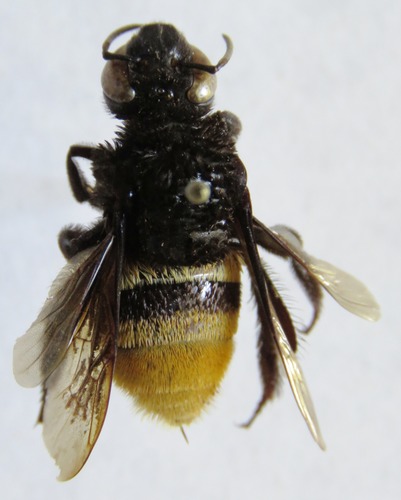
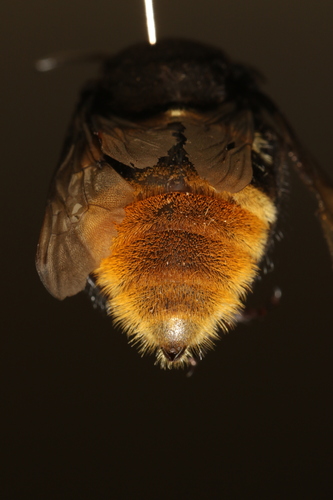
It has white spots on its face, black T1 and T3 abdominal segments, and cream-orange T2 and T4-T7 segments.
Source: Wikipedia
Size
It is a large-bodied bee with a black and orange coloration.
Source: Wikipedia
Where it lives
It can live at elevations up to 2500 m and tolerates human-disturbed habitats.
Source: Wikipedia
Where it comes from
Its range spans the Neotropics from Mexico down to Brazil.
Source: Wikipedia
Lookalikes
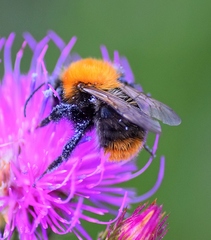
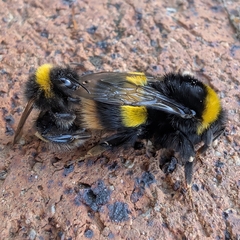
It is often mistaken for a bumblebee, but it belongs to the orchid-bee group (Euglossini).
Source: Wikipedia
Status: native in North America. Source: iNaturalist
More photos
Questions people ask
How can I tell a Belted Orchid bee apart from a bumblebee?
Look for white markings on the face and the pattern of orange and cream abdominal segments; bumblebees lack these specific colors.
Source: Wikipedia
Same family (Apidae)


Sources
- Wikipedia: https://en.wikipedia.org/wiki/Eulaema_cingulata
Look it up elsewhere: GBIF · iNaturalist · BugGuide · ITIS · Wikipedia
Text written 2026-10-23 from the sources above and checked sentence by sentence against them. Data fetched 2026-10-22.