 Bug FAQ
Beautiful Pleasing Fungus Beetle
Toramus pulchellus · Order: Coleoptera · Family: Erotylidae
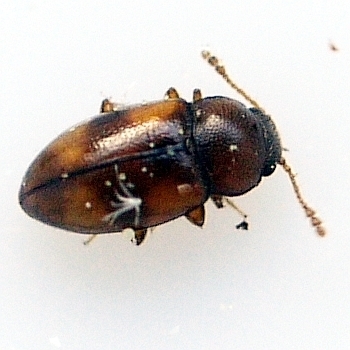
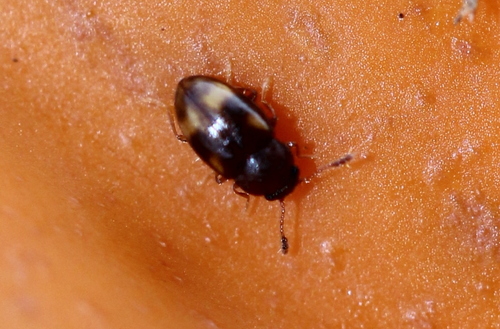
The beautiful pleasing fungus beetle is only about 1.3 mm to 1.6 mm long. Its body ranges from yellow-brown to dark colors. It lives in North America and feeds mainly on zygote fungi, which other pleasing fungus beetles usually avoid.
Source: Wikipedia
How to recognize it
The beetle’s coloration varies from yellow-brown to dark shades.
Source: Wikipedia
Size
Adults measure between 1.3 mm and 1.6 mm in length.
Source: Wikipedia
What it eats
It primarily eats zygote fungi, a food source avoided by many related beetles.
Source: Wikipedia
Where it comes from
It is found across North America.
Source: Wikipedia
Where it is found in the US
Recorded in 23 of 51 states and DC. Most records: Pennsylvania, New York, Massachusetts, Ohio, Indiana, Iowa, Kansas, Illinois.
Darker = more records. Counts are museum and citizen-science records, not population size.
Source: GBIF
Status: native in North America; native in Canada. Source: iNaturalist
Months it is reported in the US
Source: GBIF
More photos
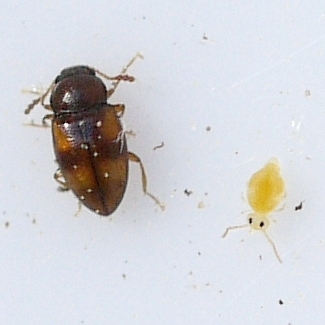
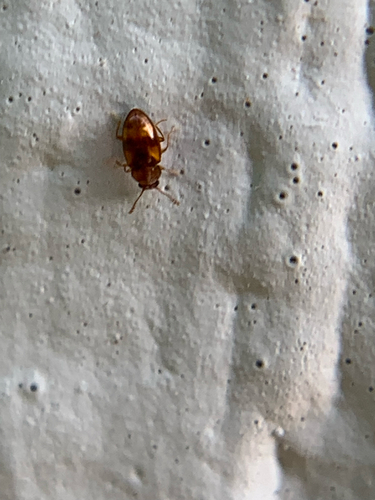
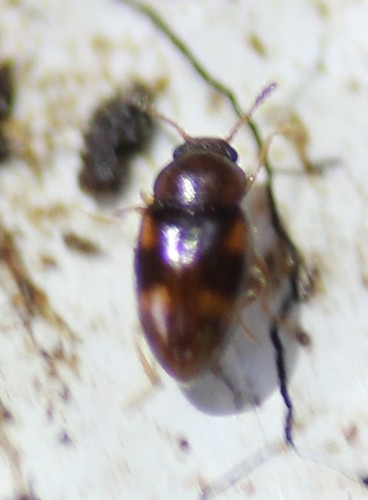
Questions people ask
What does the beautiful pleasing fungus beetle eat?
It mainly feeds on zygote fungi.
Source: Wikipedia
Same family (Erotylidae)
 Blue Fungus BeetleGibbifer californicus
 Pleasing Fungus BeetleMegalodacne heros
 Red-banded Fungus BeetleMegalodacne fasciata
 Four-spotted Fungus BeetleIschyrus quadripunctatus
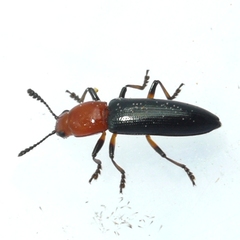 Clover Stem BorerLanguria mozardiDamages trees, gardens or crops
 Slender Lizard BeetleAcropteroxys gracilisDamages trees, gardens or crops
Sources
- Wikipedia: https://en.wikipedia.org/wiki/Toramus_pulchellus
Look it up elsewhere: GBIF · iNaturalist · BugGuide · ITIS · Wikipedia
Text written 2026-10-25 from the sources above and checked sentence by sentence against them. Data fetched 2026-10-25.