 Bug FAQ
Banded Orange Heliconian
Dryadula phaetusa · Order: Lepidoptera · Family: Nymphalidae
Also called: Banded Longwing

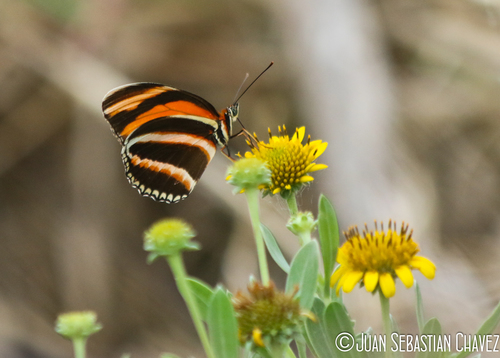
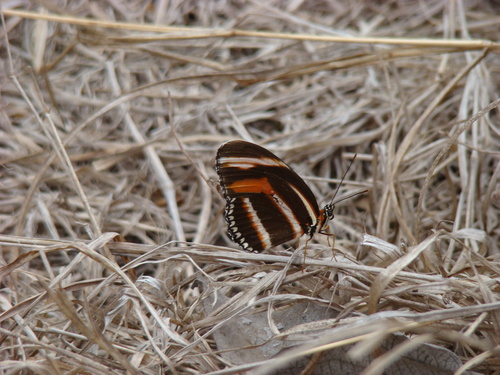
The banded orange heliconian has a wingspan of about 86 to 89 mm and is bright orange with black stripes in males, while females are a duller orange with fuzzier stripes. It lives in lowland tropical fields and valleys from Brazil up to central Mexico and may wander as far north as central Florida in summer.
Source: Wikipedia
How to recognize it
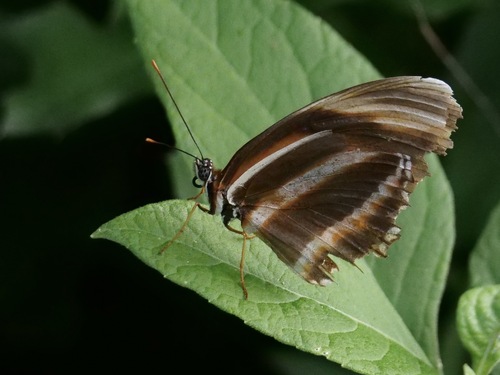
Males are bright orange with thick black stripes; females are duller orange with fuzzier black stripes.
Source: Wikipedia
What it eats
Adults feed mainly on flower nectar and bird droppings; the caterpillars eat passion-vine species such as Passiflora tetrastylis.
Source: Wikipedia
Life cycle
The species is unpalatable to birds and participates in the orange Müllerian mimicry complex.
Source: Wikipedia
When you see it
In summer it may be found as far north as central Florida, though only rarely.
Source: Wikipedia
Where it is found in the US
Recorded in 1 of 51 states and DC. Most records: Texas.
Darker = more records. Counts are museum and citizen-science records, not population size.
Source: GBIF
Months it is reported in the US
Source: GBIF
More photos
Same family (Nymphalidae)






Sources
- Wikipedia: https://en.wikipedia.org/wiki/Dryadula_phaetusa
Look it up elsewhere: GBIF · iNaturalist · BugGuide · ITIS · Wikipedia
Text written 2026-10-23 from the sources above and checked sentence by sentence against them. Data fetched 2026-10-22.