 Bug FAQ
Australasian Giant Centipede
Ethmostigmus rubripes · Order: Scolopendromorpha · Family: Scolopendridae
Also called: Australian Tiger Centipede, Giant Rainforest Centipede

Its back plates vary in brown, green, orange, or yellow shades, often with a dark edge, and its long yellow antennae have 19-20 segments, the first few being smooth.
Source: Wikipedia
How to recognize it
Antennae are yellow, long, with 19-20 segments; the first 3-4 segments are smooth.
Source: Wikipedia
Where it lives
It tolerates both dry and moist conditions and often shelters beneath logs, bark, leaf litter, or rocks.
Source: Wikipedia
What it eats
It is a solitary nocturnal predator.
Source: Wikipedia
Life cycle
Three subspecies are currently described.
Source: Wikipedia
When you see it
It is active at night.
Source: Wikipedia
Where it comes from
It is widely distributed across Asia and Oceania.
Source: Wikipedia
More photos
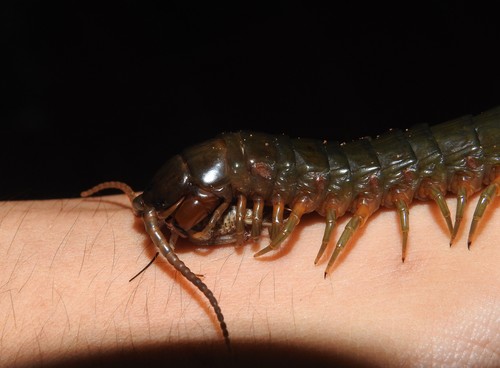
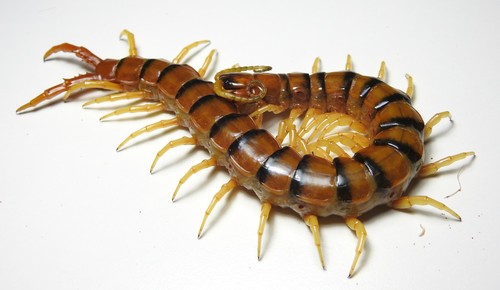
Same family (Scolopendridae)
 Common Desert CentipedeScolopendra polymorphaCan bite
 Giant Desert CentipedeScolopendra herosCan bite
 Eastern Bark CentipedeHemiscolopendra marginata
 Mediterranean Banded CentipedeScolopendra cingulataCan bite
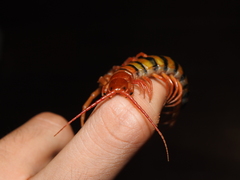 Red-headed CentipedeScolopendra morsitansCan bite
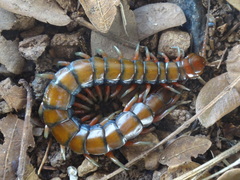 Pacific Giant CentipedeScolopendra subspinipesVenomous
Sources
- Wikipedia: https://en.wikipedia.org/wiki/Ethmostigmus_rubripes
Look it up elsewhere: GBIF · iNaturalist · BugGuide · ITIS · Wikipedia
Text written 2026-10-23 from the sources above and checked sentence by sentence against them. Data fetched 2026-10-23.