 Bug FAQ
Arctic Ringlet
Erebia disa · Order: Lepidoptera · Family: Nymphalidae
Also called: Disa Alpine, White-spot Alpine
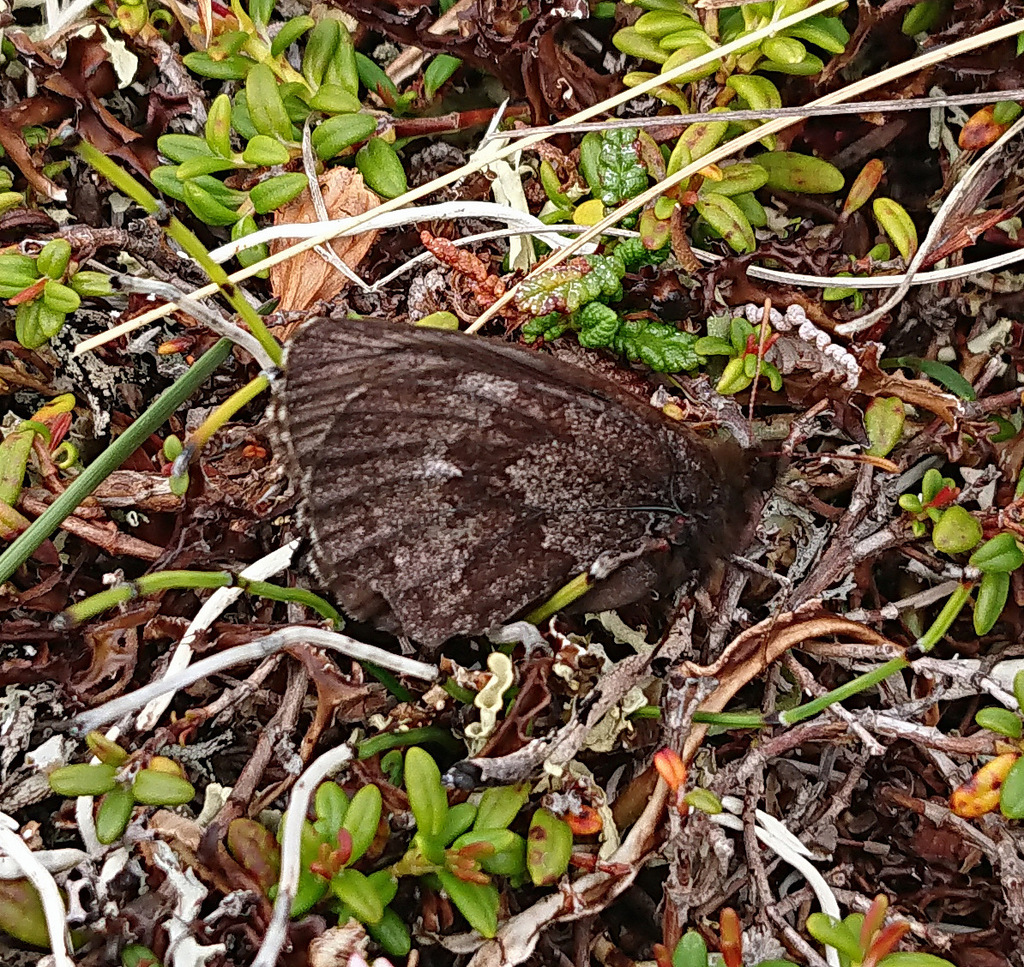
The Arctic ringlet has a wingspan of about 40-50 mm (1.6-2.0 in). Adults have dark brown upper wings with a fine black-white line along the hind margin and a red-orange band near the forewing edge bearing four black eyespots with white centres. It lives in bogs, wet muskeg and damp forests near the tree-line across the Arctic of Europe, Russia and North America.
Source: Wikipedia
How to recognize it
A red or orange strip near the forewing edge carries four black blotches that each have a white-centred eyespot.
Source: Wikipedia
Where it lives
Typical habitats are bogs and damp forests. It is especially associated with wet muskeg and bogs in sub-arctic and Arctic climates near the tree-line.
Source: Wikipedia
What it eats
Larvae feed on various grasses, cottongrasses and sedges.
Source: Wikipedia
Life cycle
The caterpillar overwinters twice before turning into an adult.
Source: Wikipedia
When you see it
Adults are on the wing mainly in July.
Source: Wikipedia
Where it comes from
It has a Holarctic distribution, occurring in Arctic Europe and Arctic North America. In Russia it is found on the Kanin Peninsula, Sajan, Irkutsk, Yakutsk and Yablonoi.
Source: Wikipedia
Where it is found in the US
Recorded in 2 of 51 states and DC. Most records: Alaska, Minnesota.
Darker = more records. Counts are museum and citizen-science records, not population size.
Source: GBIF
Status: native in North America; native in Canada. Source: iNaturalist
Months it is reported in the US
Source: GBIF
More photos
Questions people ask
What does the Arctic ringlet look like?
It has dark brown upper wings with a fine black-white line along the hind margins and a red-orange band near the forewing edge bearing four black eyespots with white centres.
Source: Wikipedia
Where can I find an Arctic ringlet?
It lives in bogs, wet muskeg and damp forests near the tree-line across the Arctic of Europe, Russia and North America.
Source: Wikipedia
Same family (Nymphalidae)






Sources
- Wikipedia: https://en.wikipedia.org/wiki/Arctic_ringlet
Look it up elsewhere: GBIF · iNaturalist · BugGuide · ITIS · Wikipedia
Text written 2026-10-23 from the sources above and checked sentence by sentence against them. Data fetched 2026-10-23.