 Bug FAQ
Arctic Blue
Agriades glandon · Order: Lepidoptera · Family: Lycaenidae
Also called: Glandon Blue, High Mountain Blue, Primrose Blue

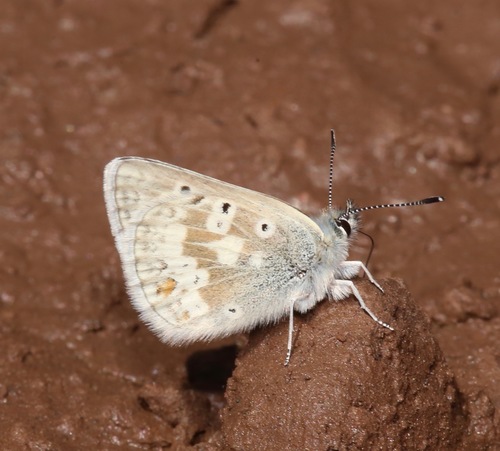
The Arctic Blue butterfly has a wingspan of about 17 to 26 mm. Males show silver-to-steely blue upper wings that turn brown toward the edges, while females are mostly brown with a hint of blue near the base.
Source: Wikipedia
How to recognize it
Male Arctic Blues have silver-shining to pale blue upper wings that become brown toward the margins. Female upper wings are largely brown with a slight bluish tint in the basal area.
Source: Wikipedia
Size
The species measures 17 to 26 mm from wing tip to wing tip.
Source: Wikipedia
What it eats
Caterpillars feed on various Androsace species, Soldanella alpina, Soldanella pusilla, and Oxytropis campestris.
Source: Wikipedia
Life cycle
Adults are on the wing from mid-May through September, depending on location.
Source: Wikipedia
When you see it
Flight period runs from mid-May to September, varying with region.
Source: Wikipedia
Where it comes from
It is found across Eurasia and North America.
Source: Wikipedia
Lookalikes
In the Pyrenees it may also be mistaken for Agriades pyrenaicus, which shares similar habitats.
Source: Wikipedia
Where it is found in the US
Recorded in 14 of 51 states and DC. Most records: Colorado, Alaska, Washington, Utah, Wyoming, New Mexico, Montana, California.
Darker = more records. Counts are museum and citizen-science records, not population size.
Source: GBIF
Status: native in North America; native in United States; native in Canada. Source: iNaturalist
Months it is reported in the US
Source: GBIF
More photos


Questions people ask
What plants do Arctic Blue caterpillars eat?
They feed on several Androsace species, Soldanella alpina, Soldanella pusilla, and Oxytropis campestris.
Source: Wikipedia
When can I see Arctic Blue butterflies?
Adults fly from mid-May to September, with exact timing depending on the location.
Source: Wikipedia
How can I tell a male Arctic Blue from a female?
Males have silver-to-steely blue upper wings that darken toward the edges, while females are mostly brown with a slight bluish tint near the base.
Source: Wikipedia
Same family (Lycaenidae)

Sources
- Wikipedia: https://en.wikipedia.org/wiki/Agriades_glandon
Look it up elsewhere: GBIF · iNaturalist · BugGuide · ITIS · Wikipedia
Text written 2026-10-23 from the sources above and checked sentence by sentence against them. Data fetched 2026-10-23.