 Bug FAQ
Apache Paper Wasp
Polistes apachus · Order: Hymenoptera · Family: Eumenidae
Also called: Apache Wasp, Texas Paper Wasp
Source: Wikipedia

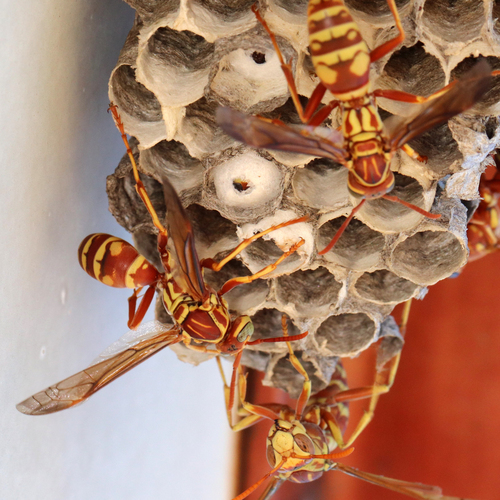
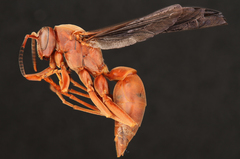
The Apache Paper Wasp is the largest bright-colored Polistes in California, reaching about 20 mm and showing golden-brown and yellow striping with distinctive yellow spots on the abdomen. It builds paper nests in vineyards, orchards, and urban eaves, and is active from February through December, often becoming a pest for farm workers during harvest.
Source: Wikipedia
How to recognize it
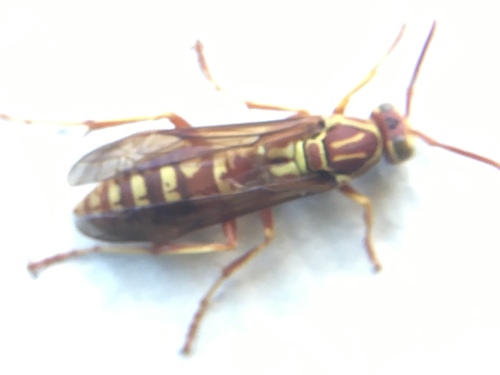
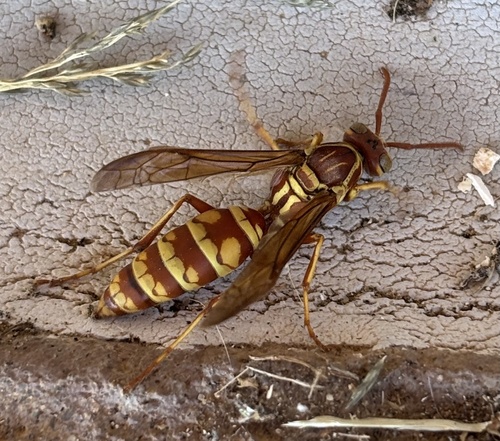
The wasp’s ground colour is golden brown, antennae are dull orange-brown, and the clypeus appears flat from the side. The pronotum has a thin yellow border, the metanotum shows two transverse yellow stripes, and the abdomen alternates golden brown and yellow bands. Two prominent yellow spots sit opposite each other on the sides of the second abdominal tergite, with smaller spots on other tergites.
Source: Wikipedia
Size
Adults can grow up to about 20 mm long.
Source: Wikipedia
Is it a pest in the house?
In California they frequently establish nests on houses, in attics or under eaves. They are considered a pest in fig orchards, where they aggressively sting farm workers during September and October harvests.
Source: Wikipedia
Does it bite or sting?
Their stings are painful, can be delivered repeatedly, and often frighten both children and adults. Stings may cause serious allergic reactions in humans and cats. Venom-specific testing has linked their stings to cases of anaphylaxis.
Source: Wikipedia
How to get rid of it
Professional exterminators are sometimes called to remove nests. Aerosol sprays with pyrethrins can knock the wasps down to the ground. Dusting nests with a 10 % DDT solution has been shown to eliminate them. One method uses a high-pressure water jet early in the morning, crushing stunned wasps that fall into the garden.
Source: Wikipedia
Where it lives
Nests are commonly found in vineyards, orchards, and urban structures such as attics and eaves. The species originally favored mesquite and grassland habitats rather than wooded areas.
Source: Wikipedia
What it eats
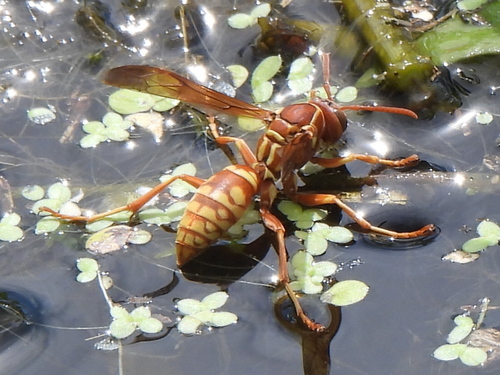
They are often seen drinking water, especially on hot, dry days.
Source: Wikipedia
Life cycle
A single overwintering female starts a new colony each spring by building a nest.
Source: Wikipedia
When you see it
In California they are active from February through December.
Source: Wikipedia
Lookalikes
It is the largest and most brightly coloured Polistes in California, helping to separate it from similar species. It resembles P. dorsalis and P. aurifer, but differs from the smaller P. exclamans which lacks abdominal spots.
Source: Wikipedia
Where it is found in the US
Recorded in 11 of 51 states and DC. Most records: Texas, California, Oklahoma, New Mexico, Colorado, Arizona, Utah, Nevada.
Darker = more records. Counts are museum and citizen-science records, not population size.
Source: GBIF
Months it is reported in the US
Source: GBIF
More photos
Questions people ask
How can I get rid of an Apache Paper Wasp nest?
Call a pest-control professional, use pyrethrin aerosol sprays, or apply a 10 % DDT dust to the nest; early-morning high-pressure water can also be effective.
Source: Wikipedia
Are Apache Paper Wasps dangerous to people or pets?
Yes, their stings are painful and can cause severe allergic reactions, including anaphylaxis, in humans and cats.
Source: Wikipedia
When are these wasps active?
In California they are seen from February through December.
Source: Wikipedia
What do they look like?
They are up to 20 mm long, golden-brown with yellow borders on the thorax, alternating golden-brown and yellow abdominal stripes, and two conspicuous yellow spots on the second tergite.
Source: Wikipedia
Same family (Eumenidae)

Sources
- Wikipedia: https://en.wikipedia.org/wiki/Polistes_apachus
Look it up elsewhere: GBIF · iNaturalist · BugGuide · Wikipedia
Text written 2026-10-22 from the sources above and checked sentence by sentence against them. Data fetched 2026-10-22.