 Bug FAQ
Annam Stick Insect
Medauroidea extradentata · Order: Phasmida · Family: Phasmatidae
Also called: Annam Walking Stick


Vietnamese walking sticks grow to about 10 to 12 cm long and are usually brown as adults, though newborns are lighter tan and they turn green after molting. Males have longer antennae and slimmer bodies, while females have shorter antennae and two small horns on the head. They live 5 to 7 months, molt six times (five for males, six for females), and can reproduce after about three months.
Source: Wikipedia
How to recognize it
Adults are various shades of brown; newborns are a smooth light tan; after a molt they become green. Males have longer antennae and thinner, smoother bodies.
Source: Wikipedia
Where it lives
They are found in tropical forests of Vietnam.
Source: Wikipedia
Life cycle
Their lifespan is short, about 5 to 7 months. Nymphs look like miniature adults, differing mainly in size. They molt roughly six times before adulthood (males five times, females six). At around three months old, after the final molt, they become capable of reproduction.
Source: Wikipedia
Where it comes from
They originate in Vietnam.
Source: Wikipedia
More photos


Questions people ask
How large do Vietnamese walking sticks get?
They grow to about 10 to 12 cm (4 to 5 inches) long.
Source: Wikipedia
What do male and female walking sticks look different?
Males have longer antennae and slimmer bodies, while females have shorter antennae and two small horns on their heads.
Source: Wikipedia
What can I feed a captive Vietnamese walking stick?
They will eat blackberry bramble, hawthorn, oak, red maple, roses, and other leafy plants.
Source: Wikipedia
Same family (Phasmatidae)
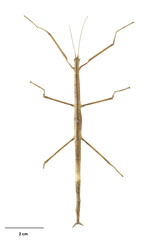 Smooth Stick InsectClitarchus hookeri
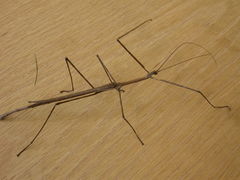 Margin-winged Stick InsectCtenomorpha marginipennisDamages trees, gardens or crops
 Prickly Stick InsectAcanthoxyla prasinaDamages trees, gardens or crops
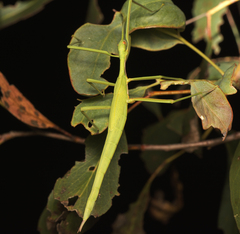 Spur Legged PhasmidDidymuria violescens
 Spiny Leaf insectExtatosoma tiaratumCan irritate skin
 Titan Stick InsectAcrophylla titan
Sources
- Wikipedia: https://en.wikipedia.org/wiki/Medauroidea_extradentata
Look it up elsewhere: GBIF · iNaturalist · BugGuide · Wikipedia
Text written 2026-10-23 from the sources above and checked sentence by sentence against them. Data fetched 2026-10-23.