 Bug FAQ
Amegilla cingulata
Amegilla cingulata · Order: Hymenoptera · Family: Apidae
Source: Wikipedia
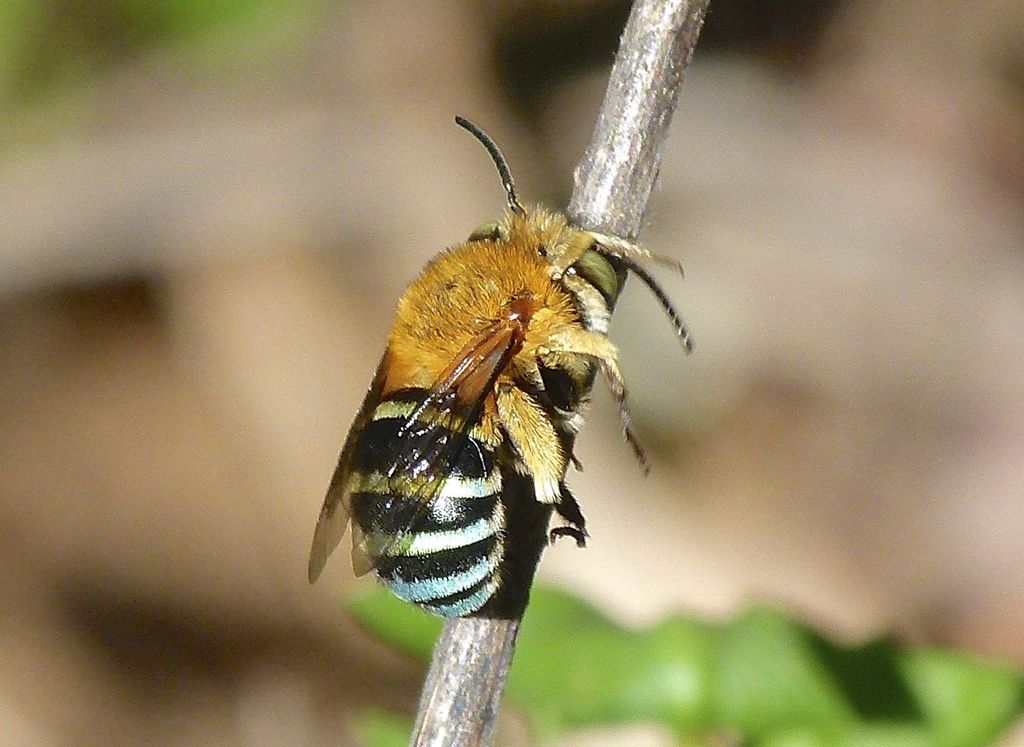
These blue-banded bees are 10 to 12 mm long and have pale opalescent blue stripes on the abdomen. They nest in dry river banks, old clay walls, mortar between bricks, or soft sandstone, often close to other members of their species.
Source: Wikipedia
How to recognize it
They look striking and similar to other Amegilla species, with pale blue abdominal stripes that set them apart from honey bees.
Source: Wikipedia
Does it bite or sting?
They can sting, though they are less aggressive than many other bees.
Source: Wikipedia
Where it lives
They are found in urban areas, woodlands, forests and heathlands. Nesting sites include dried river banks, old clay homes, mortar between bricks, and soft sandstone.
Source: Wikipedia
What it eats
They mainly collect nectar from blue flowers such as mountain devil and grey spider flower, but also visit lavender, Abelia, white Salvia, tomato, eggplant, Leea indica and some Verbenaceae.
Source: Wikipedia
Life cycle
Each female builds a solitary nest, often near other conspecifics, and provisions each cell with an egg and a pollen-nectar mixture for the larva.
Source: Wikipedia
Where it comes from
Amegilla cingulata is native to Australia.
Source: Wikipedia
Lookalikes
Males have five complete abdominal bands, while females have four, helping to tell them apart from similar species.
Source: Wikipedia
Questions people ask
Can Amegilla cingulata sting people?
Yes, they can sting, but they are not very aggressive and the sting is usually mild.
Source: Wikipedia
Where do these bees nest?
They nest in dry river banks, old clay walls, mortar between bricks, or soft sandstone, often close to other bees of the same species.
Source: Wikipedia
What do they look like?
They are small (10 to 12 mm) with pale opalescent blue stripes on the abdomen, a pattern that distinguishes them from honey bees.
Source: Wikipedia
Same family (Apidae)





Sources
- Wikipedia: https://en.wikipedia.org/wiki/Amegilla_cingulata
Look it up elsewhere: GBIF · iNaturalist · BugGuide · ITIS · Wikipedia
Text written 2026-10-23 from the sources above and checked sentence by sentence against them. Data fetched 2026-10-22.