 Bug FAQ
Ailanthus Silkmoth
Samia cynthia · Order: Lepidoptera · Family: Saturniidae
Also called: Tree of Heaven Silk Moth
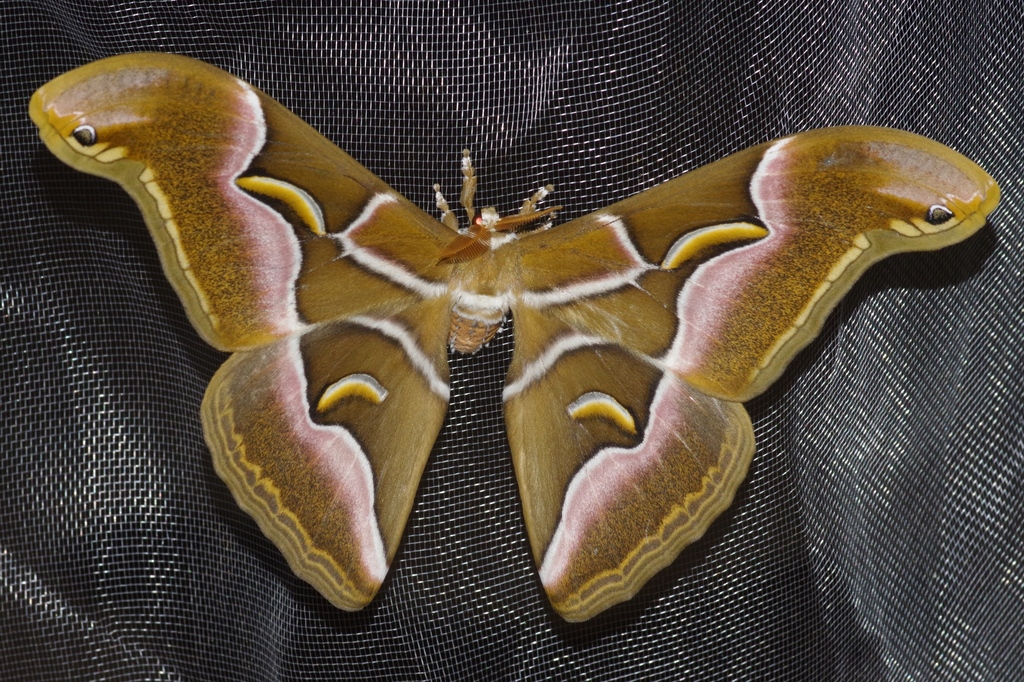
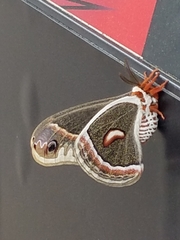
The Ailanthus silkmoth has very large wings measuring about 113 to 125 mm across. Its wings show a quarter-moon spot, whitish-yellow stripes on a brown background, and eyespots on the outer forewings. The caterpillars go through five growth stages and can reach 70 to 75 mm in length before pupating.
Source: Wikipedia
How to recognize it
Both upper and lower wings have a quarter-moon shaped spot, whitish-yellow stripes, a brown background, and eyespots on the outer forewings.
Source: Wikipedia
What it eats
Eggs are laid on tree of heaven (Ailanthus altissima) and the larvae grow best on that tree. The subspecies S. cynthia ricini feeds on castor bean plants.
Source: Wikipedia
Life cycle
The caterpillar has five instars and can reach a maximum length of 70 to 75 mm. Adult moths have no mouthparts and cannot eat or drink.
Source: Wikipedia
When you see it
In northern Europe adults fly in May and June, producing one generation.
Source: Wikipedia
Where it comes from
It is native to parts of China and Korea.
Source: Wikipedia
Where it is found in the US
Recorded in 19 of 51 states and DC. Most records: New York, Connecticut, Pennsylvania, New Jersey, Rhode Island, Ohio, Iowa, Kansas.
Darker = more records. Counts are museum and citizen-science records, not population size.
Source: GBIF
Status: introduced in United States; introduced in Canada. Source: iNaturalist
Months it is reported in the US
Source: GBIF
Questions people ask
What trees do the larvae feed on?
The larvae are laid on and grow best on the tree of heaven (Ailanthus altissima).
Source: Wikipedia
When can I expect to see adult moths?
In northern Europe they appear in May and June; in southern Europe a second partial generation may show up in September.
Source: Wikipedia
Same family (Saturniidae)


Sources
- Wikipedia: https://en.wikipedia.org/wiki/Samia_cynthia
Look it up elsewhere: GBIF · iNaturalist · BugGuide · ITIS · Wikipedia
Text written 2026-10-27 from the sources above and checked sentence by sentence against them. Data fetched 2026-10-27.