 Bug FAQ
African Rhinoceros Beetle
Oryctes monoceros · Order: Coleoptera · Family: Scarabaeidae
Also called: Coconut Beetle, Rhinoceros Beetle
Source: Wikipedia


Adult African Rhinoceros Beetles are about 4 cm long, dark reddish-brown to black, and males have a moderately long, rear-curved horn. They are common in coastal eastern Africa and across sub-Saharan Africa, including islands such as Madagascar and Réunion. Both adults and larvae attack coconut and oil palms at night, boring into the crown and feeding on undeveloped fronds, which can kill the palms.
Source: Wikipedia
How to recognize it
Males have a moderately long horn that curves strongly backward; females have a very short horn.
Source: Wikipedia
Size
Adults measure around 4 cm in length.
Source: Wikipedia
How to get rid of it
Control methods include burning breeding sites, insecticide use, trapping with attractants, protective barriers, virus introduction, and covering felled trunks with the vine Pueraria javanica. In Ivory Coast, using the vine Pueraria javanica was the most effective and easiest control method.
Source: Wikipedia
Where it lives
They are frequently reported from coastal areas of Kenya, Tanzania, Mozambique and South Africa.
Source: Wikipedia
What it eats
Adults bore into the crowns of coconut and oil palms at night and feed on the still-undeveloped fronds.
Source: Wikipedia
When you see it
Beetles attack palms shortly after dark. Population levels depend on the availability of suitable breeding sites.
Source: Wikipedia
Lookalikes
It resembles Oryctes rhinoceros in size and biology but belongs to a different subgenus.
Source: Wikipedia
More photos


Questions people ask
How does the African Rhinoceros Beetle damage palms?
Adults bore into the crown of coconut and oil palms at night and feed on the young developing fronds, which can kill the palms.
Source: Wikipedia
What control methods work against them?
Burning breeding sites, insecticides, traps with attractants, protective barriers, virus introduction, and covering felled trunks with the vine Pueraria javanica are used, with the vine being especially effective in Ivory Coast.
Source: Wikipedia
Same family (Scarabaeidae)
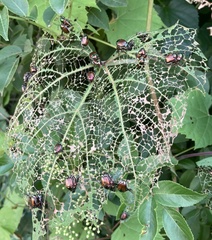 Japanese BeetlePopillia japonicaDamages trees, gardens or crops
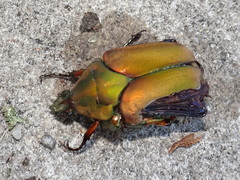 Common Green June BeetleCotinis nitidaDamages trees, gardens or crops
 Phyllophaga crinitaPhyllophaga crinitaDamages trees, gardens or crops
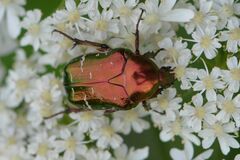 European Rose ChaferCetonia aurata
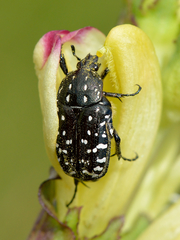 Mediterranean Spotted ChaferOxythyrea funestaDamages trees, gardens or crops
 Oriental BeetleExomala orientalisDamages trees, gardens or crops
Sources
- Wikipedia: https://en.wikipedia.org/wiki/Oryctes_monoceros
Look it up elsewhere: GBIF · iNaturalist · BugGuide · Wikipedia
Text written 2026-10-23 from the sources above and checked sentence by sentence against them. Data fetched 2026-10-23.